Float vs Inverted Bucket,Steam trap selection is often reduced to a single question: which design is better? In practice, the useful question is which trap can reliably remove condensate under the actual pressure, load and air-venting conditions of the application? Two common mechanical designs are the float and thermostatic (F&T) steam trap and the inverted bucket steam trap.
What Is an Inverted Bucket Steam Trap?
An inverted bucket steam trap contains an upside-down bucket connected to a valve mechanism. Condensate entering the trap tends to let the bucket sink, opening the discharge valve. Steam entering beneath the bucket increases buoyancy, lifting the mechanism and closing the valve. As steam condenses and condensate builds, the cycle repeats.
This is generally described as intermittent discharge. It does not mean condensate must accumulate dangerously in the upstream equipment. A properly sized and installed trap can receive condensate continuously while cycling the discharge valve. Armstrong International’s 880 Series product description explains the top-mounted mechanism, free-floating lever and small bucket vent.
Important Characteristics of Inverted Bucket Traps
- Intermittent valve operation suited to many steam main and process drainage duties.
- A water seal around the discharge arrangement helps reduce the escape of live steam.
- A bucket vent allows non-condensable gases to pass through the mechanism, although air-handling performance depends on design and load.
- Certain models feature rugged construction, integral strainers and serviceable internals.
- Capacity and operation still depend on pressure differential, correct orifice selection and proper installation.
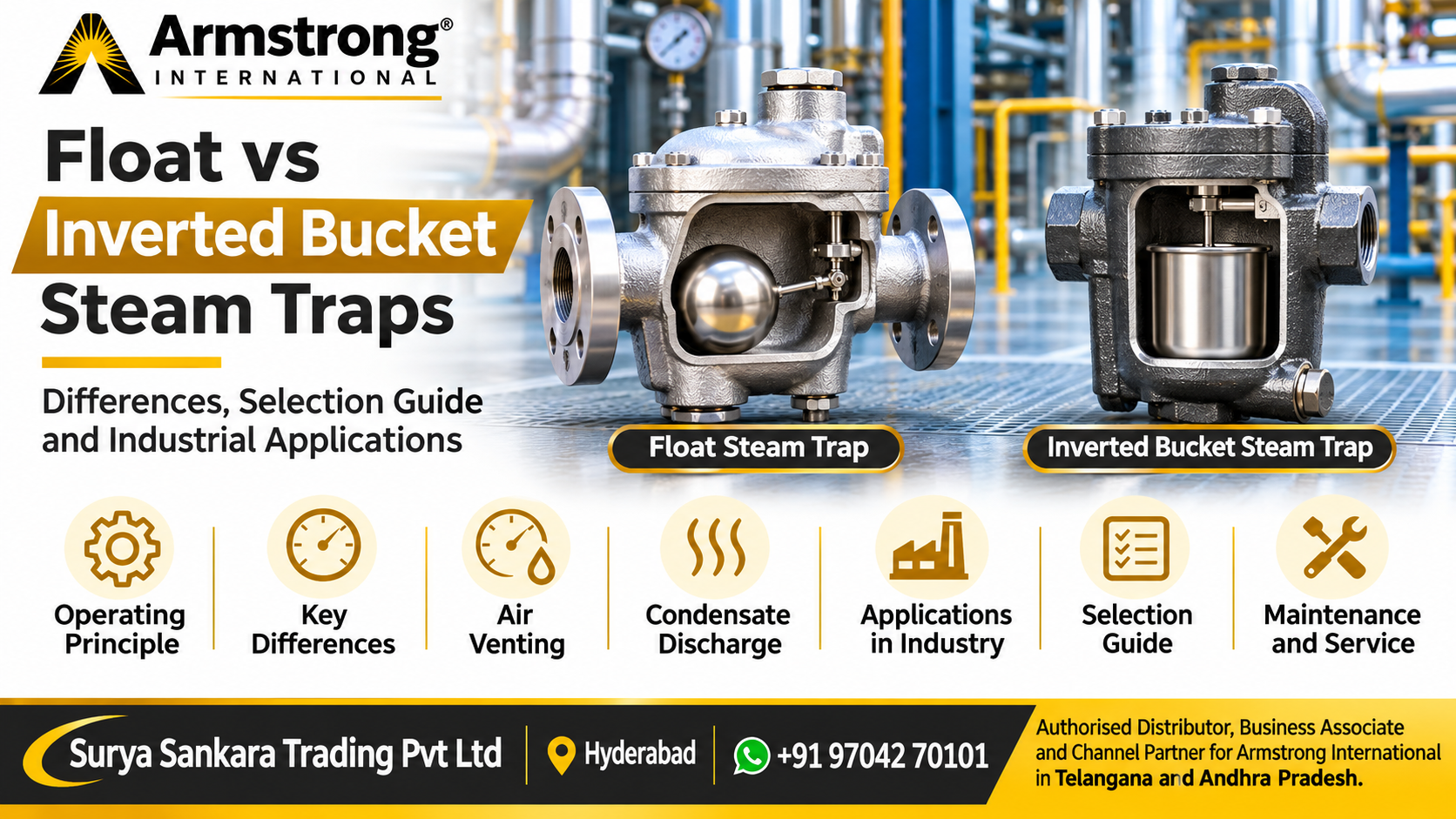
What Is a Float and Thermostatic Steam Trap?
An F&T steam trap typically uses a ball float connected to a discharge valve, plus a separate thermostatic element for venting air and other non-condensable gases. As condensate level rises, the float progressively opens the condensate valve. Air can exit through the thermostatic vent while conditions are sufficiently below steam saturation temperature; the vent closes as temperature approaches steam conditions.
This arrangement supports relatively continuous condensate drainage and high air-venting capacity in suitable models. Armstrong International describes its AIC Series F&T traps as intended for applications with varying loads and a need to vent non-condensable gases quickly.
Important Characteristics of F&T Traps
- Condensate valve opening varies with liquid level and incoming load.
- A separate thermostatic air vent can assist rapid air removal during start-up.
- Suitable models work with low or varying differential pressures, subject to their rated capacities.
- Continuous drainage can be useful for heat exchangers requiring stable condensate removal.
- Correct material, pressure rating and orientation remain essential for reliable service.
F&T traps are not automatically superior in all applications. The float, thermostatic element, vent and valve must match actual operating conditions and maintenance requirements.
Float vs Inverted Bucket Steam Traps: Key Differences
| Selection factor | Inverted bucket trap | Float and thermostatic trap |
|---|---|---|
| Condensate discharge | Generally intermittent valve cycling | Generally continuous or modulating discharge |
| Operating mechanism | Buoyant inverted bucket and lever | Liquid-level float and condensate valve |
| Air removal | Through bucket vent and discharge cycle | Separate thermostatic air vent |
| Common strengths | Rugged service, steam main drainage, many process duties | High air-venting needs, varying loads, suitable heat exchangers |
| Low differential pressure | Check rated capacity and priming requirements | Often suitable with correctly sized model |
| Maintenance focus | Water seal, bucket vent, valve, strainer | Float, thermostatic vent, valve, strainer |
| Selection limit | Must consider air loads, loss of prime, capacity | Must consider temperature, ratings, vent and capacity |
Which Trap Is Better for Steam Main Drainage?
Inverted bucket traps are widely used for steam main drip points where rugged operation and regular condensate removal are important. Their top-mounted valve arrangement and resistance to contamination can make them practical in demanding services. The trap still requires correct sizing for start-up condensate and normal operation, plus appropriate installation of a drip leg, strainer and isolation arrangement.
Which Trap Is Better for Process Heat Exchangers? Float vs Inverted Bucket
For process equipment, the best choice depends on the steam control method and how much the load changes. A heat exchanger controlled by a modulating valve may operate at much lower steam-space pressure when thermal demand decreases. That can reduce the pressure available to discharge condensate against the return system.
Understanding Stall in Modulating Systems
Stall occurs when the pressure inside a steam-heated exchanger drops to a point where the downstream return pressure prevents normal condensate drainage. Condensate may then accumulate even with a functioning trap. The solution can require piping changes, gravity drainage, a suitable pump-trap arrangement or another engineered design. Our steam pump trap package page provides a starting point for related products.
Air Venting: A Major Selection Factor
Air and non-condensable gases reduce the effectiveness of steam heating surfaces and can prolong start-up. F&T traps use a thermostatic vent separate from the condensate valve, making them attractive when rapid venting is essential. Inverted bucket traps typically vent air through a small hole in the bucket and subsequently release it during discharge; the behaviour should be checked for the anticipated air load.
Can a Separate Air Vent Be Necessary?
Yes. Some systems benefit from additional air vents at suitable locations, even when a steam trap includes air-handling features. Vent sizing, placement and selection must be based on the system’s piping arrangement and operating conditions. See our air vents product page for relevant solutions.
Pressure Differential and Back Pressure
The pressure difference across a trap is the driving force behind condensate discharge. A trap’s maximum allowable body pressure is not the same as its operating-pressure and capacity rating. Engineers should calculate the minimum expected differential pressure, not only the normal steam supply pressure.
Both inverted bucket and F&T models can operate against back pressure within their capabilities, but rising back pressure reduces the available differential and may reduce capacity. Review the manufacturer’s capacity tables for the actual orifice or model. Consider flash steam in return piping and changes caused by other steam users discharging into a common header.
Typical Applications Across Telangana and Andhra Pradesh – Float vs Inverted Bucket
Pharmaceutical plants: Utilities for process heating and facility services often need reliable drainage, especially where process temperature control is critical. Steam-trap selection is only one part of validated utility design.
Food and beverage facilities: Heat exchangers and other thermal equipment may operate with variable loads. Consider air removal, condensate quality and the return system configuration.
Textile industries: Drying machines, finishing systems and other steam users can experience large swings between start-up and production. Select traps with verified capacity at both conditions.
Common Mistakes in Steam Trap Selection
Choosing by Line Size Alone
Pipe connection size does not determine the required condensate capacity. Select using load, differential pressure, air handling, operating conditions and the relevant manufacturer data. A larger connection is not automatically a better-performing trap.
Ignoring the Return Header
An apparently correct trap can fail to drain adequately when the return header develops excessive back pressure. Evaluate the entire network, particularly if several process units discharge to the same line.
Treating Every Discharge Pattern as a Failure
Intermittent discharge is normal for many inverted bucket traps, while a steady or modulating pattern can be normal for F&T traps. Diagnosis depends on the trap design, load and measurement results. Sound or temperature alone is not enough to classify all traps reliably.
Neglecting Routine Testing
A trap survey helps locate failed-open, failed-closed and abnormal units. Use a planned inspection programme and appropriate instruments. Our steam trap testing solutions page explains a related Armstrong International testing product.
Practical Steam Trap Selection Checklist
Confirm the Application Before Selecting a Model
Document normal and maximum condensate load, start-up conditions, steam pressure range, minimum outlet pressure, allowable condensate backup, ambient conditions, available installation orientation and maintenance access. Identify whether separate air venting or a pump-trap package is required.
Questions to Ask the Supplier
- What is the rated capacity at our minimum differential pressure?
- How does the model vent air during start-up?
- What happens when the control valve reduces steam pressure?
- Which strainers, check valves and isolation fittings are recommended?
- What inspection and maintenance procedures apply to this particular series?
Essential Engineering Reminder
Never assume that a steam trap alone can lift condensate against a return pressure higher than the steam-space pressure. Detailed system engineering may require gravity drainage or a pumping arrangement.
Frequently Asked Questions: Float vs Inverted Bucket
Which trap is generally preferred for high air loads?
An appropriately selected float and thermostatic trap often provides an advantage when rapid air venting is important because it includes a separate thermostatic air vent. The final choice depends on the specific model and application.
Does an inverted bucket steam trap waste steam when it cycles?
A properly operating inverted bucket trap is designed to discharge condensate while restricting live steam through a water-seal mechanism. Steam loss is possible if a trap is damaged, incorrectly selected or operated outside its intended conditions.
Is continuous discharge always better than intermittent discharge?
No. Discharge pattern is only one selection factor. Equipment drainage, load variation, air handling, pressure differential and reliability are more important than whether flow appears continuous.
Can either trap work with a modulating steam control valve?
Potentially, but the pressure difference across the trap can fall as the control valve throttles. At low or negative differential pressure, a separate engineered condensate-removal solution may be needed.
How do I know whether my existing trap is working?
Use the manufacturer’s operating guidance and a suitable survey method, combining measurements and knowledge of the load. An inverted bucket trap and an F&T trap can sound different when both are healthy.
Ask for Steam Trap Selection Support in Hyderabad
Surya Sankara Trading Pvt Ltd is an Authorised Distributor, Business Associate and Channel Partner for Armstrong International in Telangana and Andhra Pradesh. From Hyderabad, we support industrial customers seeking Armstrong International steam traps and related steam and condensate management solutions.
Engineers and purchase teams in Hyderabad, Medchal, Sangareddy, Warangal, Vijayawada, Visakhapatnam, Guntur and nearby industrial centres can share operating conditions for a technical product discussion. To review our related range, visit the inverted bucket trap product page and the Armstrong International solutions homepage.
For product enquiries on Float vs Inverted Bucket: Call or WhatsApp +91 97042 70101, or email suryasankaratraders@gmail.com. Please provide the steam pressure, condensate load and return-line details so that the discussion begins with useful engineering information.