Author name: Surya Sankara Trading Pvt Ltd

Steam Trap Testing Methods
Blog

Steam Trap Testing Methods for Industrial Maintenance Teams

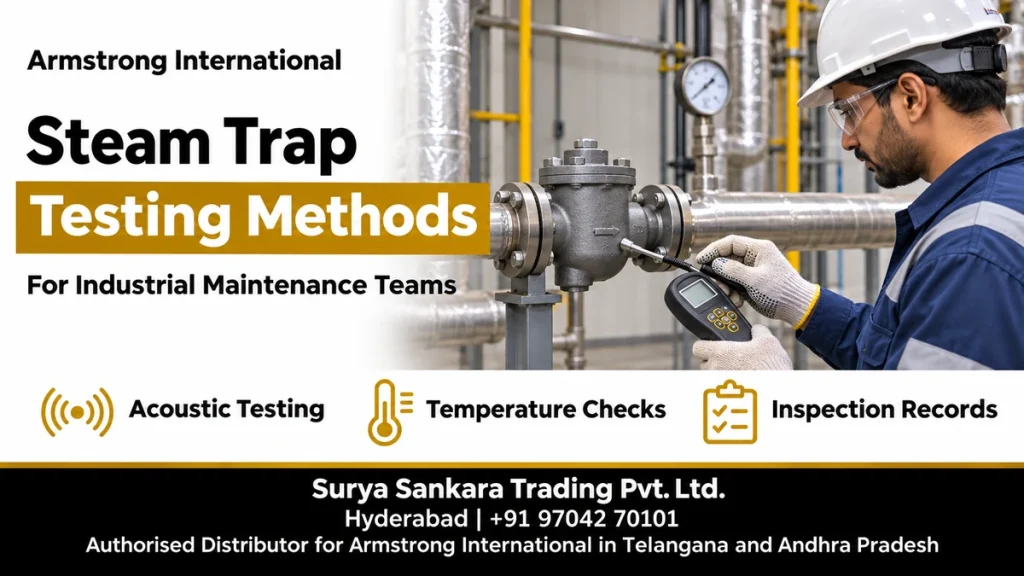
What Is Steam Trap Testing? Steam trap testing methods include visual inspection, surface temperature checks, contact ultrasound or acoustic testing, and observation through a purpose-designed sight glass or monitoring device. The most useful approach combines the readings with three facts: the trap type, whether steam is available at the inlet, and whether the equipment is producing condensate. A single hot reading or a short burst of noise is not enough to diagnose a failure. Steam traps discharge condensate and help limit the escape of live steam. When a trap leaks, the plant can lose energy without seeing an external plume. When condensate cannot drain, the equipment may heat slowly or unevenly. Finding the difference helps a maintenance team decide whether to investigate the trap, the steam supply or the condensate return system. Why Test Steam Traps Under a Known Load? Sound and temperature change as a process starts, reaches temperature, idles or stops. A cold trap on an isolated branch does not tell you how it would behave in service. Similarly, a quiet trap at low load may be between discharge cycles. If you cannot establish the operating state, mark the result as inconclusive and return when the equipment is running. Different designs also produce different patterns. An inverted bucket steam trap can discharge intermittently. A float and thermostatic trap may discharge more continuously under a steady load. Continuous flow on its own is not proof that a float trap is passing live steam, just as cycling alone does not prove an inverted bucket trap is sealing correctly. What Can a Steam Trap Test Reveal? A routine survey can flag a trap that appears to operate normally, one that may be leaking or blowing through, and one that is cold or not draining as expected. Treat these as findings to interpret. For example, a cold trap could reflect a closed isolation valve, a restriction, or a genuine failure. High back pressure can also prevent drainage even when the trap mechanism works. Keep live steam and flash steam separate in your diagnosis. Hot condensate can form flash steam when its pressure drops. Vapour in an approved observation point may therefore occur during normal discharge. Compare the pattern with the trap design and the process load before deciding that a plume, a hot return line or a noisy outlet indicates live steam leakage. When Should Maintenance Teams Test Steam Traps? Use consistent steam trap testing methods to compare readings over time, but set the survey interval according to plant risk. Give greater priority to units serving critical heat exchangers, continuously operating steam mains and processes where poor drainage affects product quality or production. Also schedule a check after an unexpected heating problem, recurring condensate backup or repair. A practical survey route groups equipment by area and expected operating window. A batch reactor may need to be checked during a representative heating stage, while a main drip trap can be assessed when the distribution line is in service. Coordinate with operations so an idle branch is not mistaken for a failed trap and important test opportunities are not missed. How to Test Steam Traps and Act on the Findings Method 1 – Visual Inspection and Operating Checks Confirm the tag, trap type, equipment duty and reported operating state. Look from an approved position for obvious external leakage, damaged supports, unusual vibration or signs of poor drainage. Review accessible pressure readings and the status of the steam supply and return system. Visual checks help decide where to investigate, but they do not establish whether a closed-return trap is leaking internally. Follow plant safety procedures and use approved access and test points. Never loosen a fitting or open a pressurised trap to look for discharge. Any inspection requiring disassembly must follow the site’s isolation, depressurisation and cooling procedures. Method 2 – Contact or Infrared Temperature Checks Measure the surface temperature at consistent, accessible points specified in the testing procedure. Compare the inlet and outlet readings with the steam pressure and the operating state. An unexpectedly cool inlet during a confirmed heating duty calls for a supply or flow check. A hot outlet can occur with normal hot condensate or flash steam, so temperature alone does not reliably confirm leakage. For non-contact infrared measurements, use a suitable target surface and follow instrument guidance on emissivity and distance. Shiny metal and inconsistent target locations can produce misleading comparisons. Record the measurements as surface temperatures, not direct measurements of the steam or condensate inside the pipe. Method 3 – Contact Ultrasound or Acoustic Testing A contact ultrasonic or acoustic instrument picks up sound transmitted through the metal as steam or condensate moves. Use the manufacturer’s recommended measurement point and listen long enough to catch the expected discharge pattern. For an intermittent trap, listen between cycles as well as during discharge. An unusually persistent signal can justify further investigation, especially when the trap would normally close between cycles. Compare the reading with adjacent pipework if a nearby control valve, pump or trap may be contributing noise. There is no universal sound level that identifies a failed trap across all types and pressures. Use the test instrument correctly and judge the signal alongside temperature, load and the normal behaviour of that model. Method 4 – Sight Glass or Installed Monitoring A pressure-rated sight glass installed for the purpose can help an operator observe discharge without opening the circuit. It provides visual context, but flash steam and changing condensate loads still make interpretation important. Where repeated manual access is difficult or the service is critical, a suitable monitoring system can help flag changes between surveys. Select the device and its location for the installation rather than assuming one method fits every duty. Bring the Readings Together in a Steam Trap Survey For most portable surveys, combine steam trap testing methods rather than relying on one reading. Start with an operating check, then compare temperature and acoustic results. The Armstrong International SAGE UMT® steam trap tester combines a contact acoustic sensor
Condensate Recovery System
Blog

Condensate Recovery System | Armstrong International

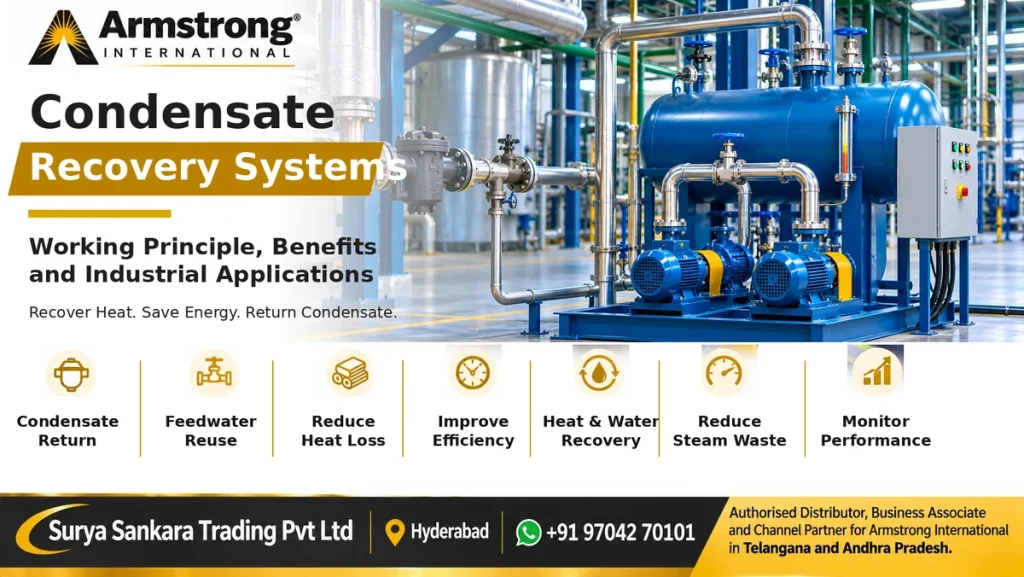
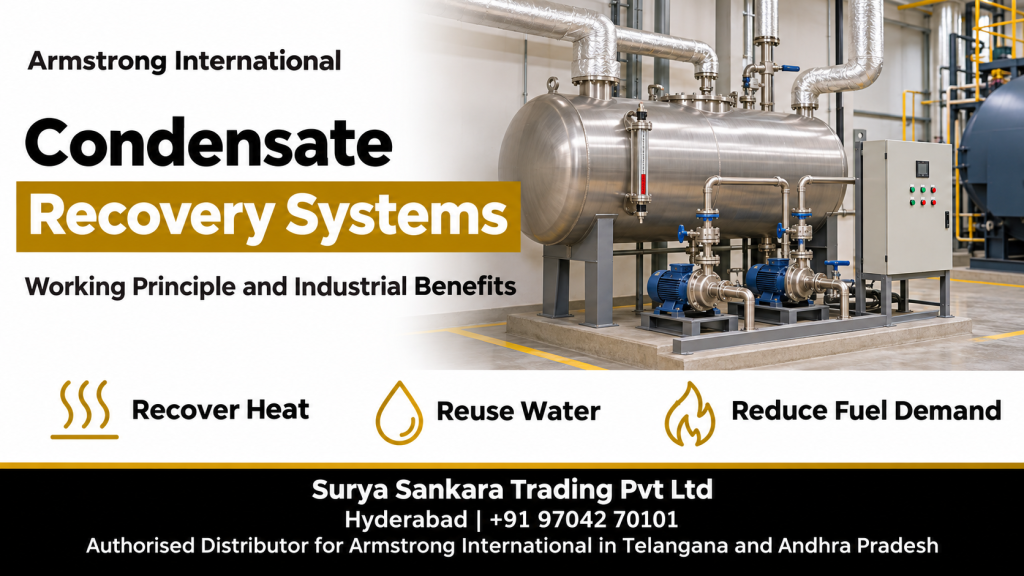
Condensate Recovery Systems: Working Principle and Industrial Benefits. A Condensate Recovery System plays an important role in improving industrial steam efficiency by collecting hot condensate and returning it for reuse in the boiler feedwater system. Industrial plants that discharge recoverable condensate unnecessarily may lose valuable thermal energy, treated water and boiler chemicals. In pharmaceutical, textile, food processing, chemical, paper and sugar industries, steam is widely used for heating, drying and other manufacturing operations. Once steam transfers its heat, it becomes condensate that may still contain significant recoverable energy. Armstrong International offers advanced condensate management technologies, including steam pump trap packages, mechanical pumping systems and related steam solutions. Surya Sankara Trading Pvt Ltd is an Authorised Distributor, Business Associate and Channel Partner for Armstrong International in Telangana and Andhra Pradesh. Based in Hyderabad, the company supports industrial customers with product enquiries, application discussions and technical coordination. What Is a Condensate Recovery System? A condensate recovery system collects water formed when steam releases its heat to industrial equipment. Instead of discharging suitable condensate into drains, the system returns it to a condensate collection tank, boiler feedwater system or another designated recovery point. Recovered condensate can provide two valuable resources: Thermal energy: Hot condensate requires less additional heating than cold make-up water. Treated water: Suitable condensate can reduce the quantity of fresh water and treatment chemicals needed for boiler operation. The amount of energy recovered depends on condensate temperature, flow rate, recovery efficiency and plant operating conditions. Condensate quality must be verified before reuse because contaminated condensate can damage boiler systems. How Does a Condensate Recovery System Work? Industrial condensate recovery involves several stages. 1. Steam Transfers Heat to Equipment Steam from the boiler enters industrial equipment such as heat exchangers, heating coils, dryers or jacketed vessels. As steam releases latent heat, it condenses into hot water. 2. Steam Traps Discharge Condensate Correctly selected steam traps discharge condensate while restricting unnecessary live steam losses. Armstrong International offers different steam trap technologies for industrial operating conditions, including inverted bucket steam traps. 3. Condensate Enters the Return System Discharged condensate flows through suitable return piping toward a collection receiver or recovery system. Depending on pressure and piping arrangement, condensate may move by gravity or require pumping. 4. Condensate Is Collected and Pumped Where gravity drainage is insufficient, a condensate recovery pump or pressure-operated pump trap can move condensate against elevation or return-line pressure. Some Armstrong International pumping technologies operate using steam or compressed gas rather than electricity. 5. Recovered Condensate Is Reused Acceptable condensate can be returned to the boiler feedwater system, subject to water quality, temperature and boiler operating requirements. This reduces the need for fresh make-up water and the associated heating energy. Main Components of a Condensate Recovery System An industrial recovery installation may contain: Component Primary function Steam traps Remove condensate while limiting live steam discharge Condensate return piping Transport condensate to a recovery point Condensate receiver Collect condensate before pumping Condensate pump or pump trap Move condensate against elevation or back pressure Check valves Prevent undesirable reverse flow Flash steam recovery equipment Recover useful flash steam where feasible Monitoring instruments Measure operating conditions and system performance The actual equipment arrangement depends on the process, recovery pressure and plant layout. Key Industrial Benefits of Condensate Recovery Systems 1. Reduced Fuel Consumption Recovered hot condensate requires less energy to reach boiler feedwater conditions compared with cold make-up water. This can reduce boiler heating requirements and fuel consumption. 2. Lower Water Consumption Returning suitable condensate decreases the need for fresh boiler make-up water. This is especially valuable for industrial plants seeking better water resource management. 3. Reduced Water Treatment Costs Boiler make-up water normally requires treatment to control scale, corrosion and other operating problems. Recovering acceptable condensate can reduce the volume of water requiring treatment and associated chemical consumption. 4. Improved Steam System Efficiency Effective condensate removal helps steam-heated equipment operate efficiently while returning recoverable heat to the boiler system. 5. Reduced Wastewater Discharge Reusing condensate can decrease the volume of hot water discharged to drains or wastewater treatment systems. Environmental and disposal benefits depend on the existing plant arrangements. 6. Support for Energy Conservation Condensate recovery is an important part of broader steam system energy management. Actual savings should be calculated from measured plant data rather than assumed percentages. Armstrong International Condensate Recovery Solutions Armstrong International provides several technologies for industrial condensate management. Steam Pump Trap Packages Armstrong International engineered pump trap packages are designed for suitable condensate drainage and recovery applications. These packages can incorporate pumping equipment, receivers, check valves, isolation valves, piping and monitoring components. They may help simplify installation and condensate handling in demanding industrial applications. Related product: Armstrong International Steam Pump Trap Package Mechanical Pumping Traps Armstrong International offers non-electric pumping trap technologies for moving condensate from low-pressure, low-elevation or vacuum systems to higher-pressure recovery points. For example, its EPT Series includes pressure-operated pumping traps designed for selected high-temperature condensate applications. Steam Trap and Pump Combinations Armstrong International Double Duty® technologies combine steam trapping and pumping functions for suitable process heat exchangers and heating coils. These arrangements can be useful where modulating steam pressure creates condensate drainage difficulties. Model availability, operating limits and system suitability must be confirmed against manufacturer documentation. How to Select the Right Condensate Recovery System Before selecting a condensate recovery system, engineers should evaluate: Total condensate generation rate in kg/h Normal and maximum condensate temperature Steam and condensate return pressures Required pumping elevation Available filling head for pumping equipment Condensate quality and contamination risk Flash steam generation and recovery opportunities Pipeline routing and pressure losses Equipment operating hours and load variations Boiler feedwater and water treatment requirements For steam-heated equipment with modulating control valves, stall conditions deserve particular attention. A stall can occur when pressure inside the steam-heated equipment becomes insufficient to overcome condensate return back pressure. In such situations, replacing the steam trap alone may not resolve the problem. An appropriately engineered pump-trap system may be required. Industrial Applications of Condensate Recovery Pharmaceutical

Reduce Steam Losses in Plants
Blog

Reduce Steam Losses in Plants | Armstrong International

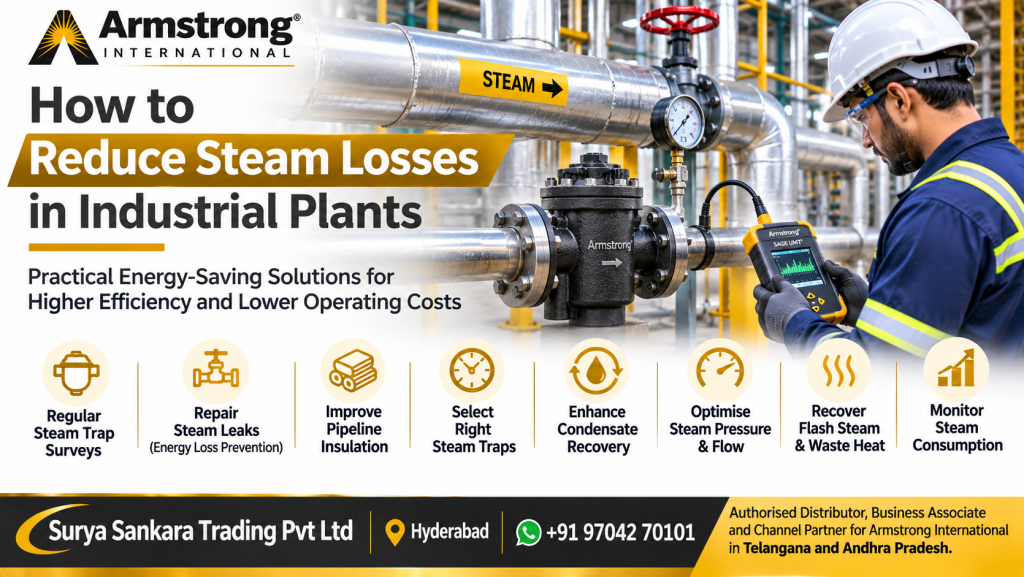
How to Reduce Steam Losses in Industrial Plants: Practical Energy-Saving Solutions. Learning how to reduce steam losses in industrial plants is essential for improving energy efficiency, controlling fuel costs and maintaining reliable manufacturing operations. Steam is widely used in pharmaceutical, food processing, textile, chemical, paper and sugar industries for heating, drying, sterilisation-related utilities and other processes. However, leaking steam pipelines, malfunctioning steam traps, damaged insulation and inefficient condensate recovery can lead to avoidable energy consumption. Reducing steam losses requires a systematic approach that evaluates steam generation, distribution, utilisation and condensate return. Armstrong International offers industrial steam traps, steam trap testing equipment, pressure reducing valves, steam flow meters and condensate management technologies that support efficient steam system operation. Surya Sankara Trading Pvt Ltd is an Authorised Distributor, Business Associate and Channel Partner for Armstrong International in Telangana and Andhra Pradesh. Based in Hyderabad and established in 2011, the company supports industrial customers with steam and thermal utility product enquiries and technical coordination. What Causes Steam Losses in Industrial Plants? Steam losses occur when useful steam escapes from the system or when thermal energy is wasted before reaching the intended process. The main causes include: Leaking steam pipes, valves and flanges Failed-open or leaking steam traps Uninsulated steam distribution pipelines Excessive or uncontrolled steam venting Inefficient condensate recovery Inappropriate operating pressures Poor steam system maintenance Unnecessary steam consumption during idle periods It is important to distinguish between live steam leakage and heat loss. Live steam leakage represents an actual loss of steam mass from the system. Heat loss occurs when thermal energy escapes through piping, equipment surfaces or other components, increasing the steam required to maintain process conditions. Both can increase industrial energy costs. 8 Practical Ways to Reduce Steam Losses in Industrial Plants 1. Conduct Regular Steam Trap Surveys Steam traps remove condensate and non-condensable gases while limiting live steam discharge. A malfunctioning steam trap may leak live steam continuously or prevent adequate condensate drainage. Regular steam trap surveys help maintenance teams identify faulty equipment and prioritise corrective work. Armstrong International offers the SAGE UMT® Automatic Steam Trap Tester, which uses acoustic and infrared temperature measurements to evaluate steam trap operating conditions. Systematic surveys can support: Detection of leaking or blocked steam traps Better maintenance planning Reduction of avoidable steam losses Improved condensate drainage More reliable steam system performance Related product: Armstrong International Steam Trap Tester 2. Repair Steam Pipeline and Valve Leaks Steam leaks can occur at pipe joints, valve stems, flanges, gaskets and equipment connections. Even relatively small leaks may create substantial cumulative losses when a plant operates continuously. Industrial maintenance teams should establish regular inspections to locate visible and suspected steam leakage points. Leak assessment should consider operating pressure, location, severity and safety risks. Corrective actions may involve approved gasket replacement, valve repair or pipeline maintenance. All repairs must follow proper isolation, depressurisation and plant safety procedures. 3. Improve Steam Pipeline Insulation Uninsulated steam pipelines release thermal energy into the surrounding environment. Damaged, missing or wet insulation can also increase heat losses from steam distribution systems. Effective insulation helps reduce heat transfer to the surroundings and supports more efficient delivery of steam to process equipment. Industrial plants should inspect: Steam distribution pipelines Valves and flanges Steam separators Condensate return lines Heating equipment surfaces Removable insulation jackets can be considered for suitable valves and fittings requiring periodic maintenance. 4. Select Appropriate Steam Traps Correct steam trap selection is essential for effective condensate management. An unsuitable steam trap may fail to handle condensate loads, operate inefficiently under changing conditions or provide inadequate air removal. Important selection parameters include condensate load, inlet pressure, return-line pressure, pressure differential and installation requirements. Armstrong International provides several steam trap technologies, including inverted bucket, float and thermostatic, disc and thermostatic designs. Related product: Armstrong International Inverted Bucket Steam Trap The final selection should follow manufacturer capacity charts and application-specific recommendations. 5. Improve Condensate Recovery Condensate discharged from steam-heated equipment often retains useful thermal energy. When suitable condensate is returned to the boiler feedwater system, it can reduce the demand for cold make-up water, additional heating energy and water treatment chemicals. Inefficient condensate recovery may result from unsuitable piping, excessive back pressure, defective equipment or unnecessary discharge to drains. A properly designed condensate recovery system should account for condensate quantity, temperature, pressure and contamination risks. Armstrong International provides condensate management technologies and steam pump-trap arrangements for suitable industrial applications. Related product: Steam Pump Trap Package 6. Optimise Steam Pressure and Flow Control Steam pressure should be appropriate for the equipment and process requirements. Excessive distribution pressure can increase the driving force for leakage and may contribute to unnecessary energy losses. However, reducing pressure without engineering assessment can impair process heating, steam trap discharge and condensate return performance. Armstrong International pressure reducing valves, control valves and steam flow measurement technologies can support suitable pressure regulation and consumption monitoring. Engineers should evaluate minimum process pressure, peak demand, control stability and steam system safety before making pressure changes. 7. Recover Flash Steam and Waste Heat When high-temperature condensate enters a lower-pressure system, part of the condensate may evaporate into flash steam. This is a normal thermodynamic phenomenon and should not automatically be confused with steam trap leakage. In suitable installations, flash steam can be recovered and used for lower-pressure heating requirements. Industrial heat recovery opportunities may also exist in boiler exhaust, hot process water and other thermal streams. The technical and economic feasibility depends on operating conditions, temperature levels, system design and the availability of useful heat demand. 8. Monitor Steam Consumption and Maintain Boilers Steam flow meters help industrial plants establish consumption baselines and identify unusual changes in steam demand. Monitoring can support comparisons between departments, production shifts and individual process equipment. Boiler maintenance is equally important because inefficient combustion, unnecessary blowdown and poor heat transfer increase fuel consumption. Plants should maintain appropriate combustion settings, water treatment, boiler controls and preventive maintenance schedules. Unused steam lines and equipment should be reviewed for safe isolation where operationally appropriate.

Steam Trap Failure Causes
Blog

Steam Trap Failure Causes: Common Problems, Testing and Troubleshooting

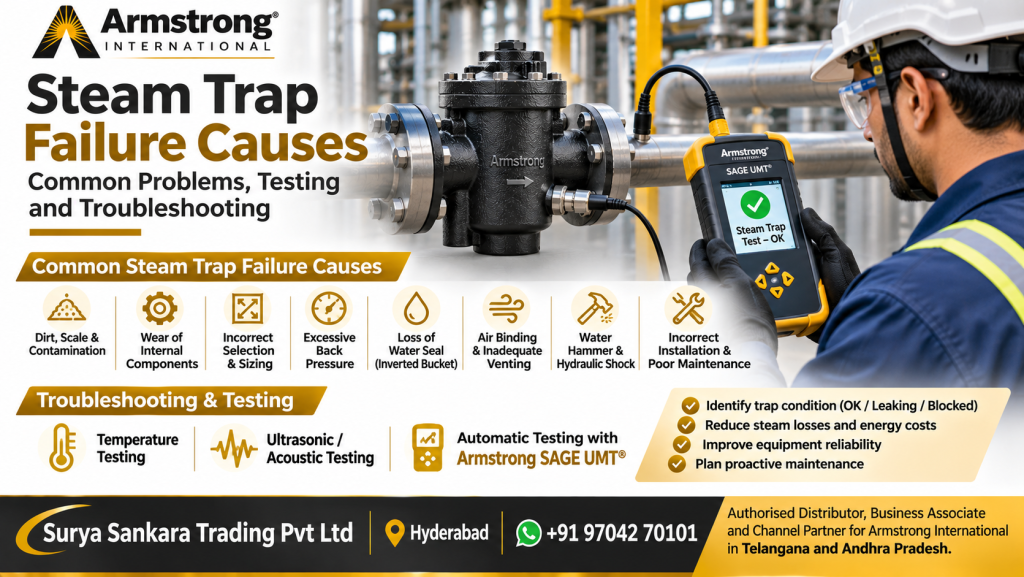
Steam Trap Failure Causes are an important concern for industries operating steam distribution networks, process heating equipment and condensate recovery systems. A malfunctioning steam trap can result in live steam leakage, condensate accumulation, reduced heat transfer efficiency, water hammer and increased energy consumption. Industrial steam systems depend on correctly functioning steam traps to remove condensate and non-condensable gases while minimising unnecessary steam loss. Understanding the causes of steam trap failures, recognising warning signs and performing systematic testing can help maintenance engineers improve operational reliability. Armstrong International provides industrial steam traps, testing technologies and steam system management solutions to support efficient condensate drainage and preventive maintenance. Surya Sankara Trading Pvt. Ltd. (SSTPL) is an Authorised Distributor, Business Associate and Channel Partner for Armstrong International in Telangana and Andhra Pradesh. Based in Hyderabad and established in 2011, SSTPL supports industrial customers with Armstrong International product enquiries and technical coordination. What Happens When an Industrial Steam Trap Fails? A steam trap is an automatic device designed to discharge condensate and certain non-condensable gases while limiting live steam losses. When it malfunctions, two common conditions may occur: Failure condition Possible consequences Failed Open Continuous steam leakage, energy losses and increased condensate return system loading Failed Closed Condensate accumulation, poor heating, water hammer risk and production problems Not all steam trap problems are caused by damaged internal components. Inadequate pressure differential, blocked strainers and incorrect installation can create similar symptoms. Therefore, effective troubleshooting must consider the complete steam and condensate system, rather than examining the steam trap alone. 8 Common Steam Trap Failure Causes 1. Dirt, Scale and Pipeline Contamination Industrial steam pipelines may contain rust, welding debris, scale and other solid particles. These contaminants can accumulate inside steam traps, obstruct discharge passages or prevent valve mechanisms from closing properly. Common symptoms: Restricted condensate discharge, irregular operation or continuous steam leakage. Prevention: Maintain appropriate upstream strainers, remove accumulated debris and investigate recurring contamination sources. Armstrong International offers inverted bucket steam trap designs with dirt-resistant features, but proper pipeline cleanliness remains essential. 2. Wear of Internal Components Steam trap components experience repeated opening and closing cycles, pressure fluctuations and prolonged exposure to elevated temperatures. Over time, valve seats, discs, thermostatic elements and mechanical components may deteriorate. Worn sealing surfaces can permit live steam to pass through the outlet, increasing energy losses. Prevention: Conduct periodic inspections and replace worn components using approved spare parts. Some Armstrong International steam trap models feature repairable internal mechanisms, which may reduce the need to replace the complete unit. 3. Incorrect Steam Trap Selection and Sizing Selecting an unsuitable steam trap is another important cause of operating problems. Steam traps must be sized according to condensate load, operating pressure, back pressure, start-up conditions and application requirements. An undersized trap may not discharge condensate adequately, while an unsuitable design may provide insufficient air removal. Prevention: Use manufacturer capacity charts and application guidance instead of selecting a trap solely by pipe diameter. Correct equipment selection is particularly important for steam-heated process equipment with changing operating conditions. 4. Excessive Condensate Return Back Pressure High pressure in the condensate return line reduces the pressure differential available for steam trap discharge. This may result from undersized return piping, restrictions, excessive flash steam or other system problems. When insufficient differential pressure is available, condensate may accumulate even if the trap mechanism is functioning. Prevention: Evaluate the downstream condensate return system and verify the available pressure differential. Where process equipment experiences steam stall, a properly engineered pump-trap arrangement may be necessary. 5. Loss of Water Seal in Inverted Bucket Steam Traps Inverted bucket steam traps rely on a water seal to prevent unnecessary live steam discharge. Sudden or frequent pressure drops may cause the trap to lose its prime. When this happens, steam may escape through the discharge valve until the water seal is restored. Prevention: Review pressure fluctuations and installation conditions. Follow the applicable Armstrong International instructions for priming and any recommended check-valve arrangement. 6. Air Binding and Inadequate Venting Air and non-condensable gases can accumulate in industrial steam-heated equipment. If the air venting arrangement is inadequate or blocked, the system may experience delayed heating, uneven temperatures or poor condensate drainage. Some float and thermostatic steam traps may become air-bound when their thermostatic vents malfunction. Prevention: Verify air removal requirements, inspect appropriate venting equipment and select steam traps suited to the application’s start-up conditions. 7. Water Hammer and Hydraulic Shock Water hammer can occur when condensate accumulates in steam piping and is rapidly accelerated or when other sudden hydraulic events occur. The resulting forces may damage steam trap components, valves and surrounding pipework. Hydraulic shock can also damage certain thermostatic elements. Prevention: Provide suitable drainage arrangements, correct pipe slopes and appropriate steam trap locations. Persistent water hammer requires investigation of the wider steam system, not merely replacement of damaged traps. 8. Incorrect Installation and Inadequate Maintenance Installing a steam trap in the wrong orientation, reversing its flow direction or providing unsuitable piping arrangements can interfere with normal operation. Maintenance deficiencies may allow dirt accumulation, leaking valves or worn components to remain undetected. Prevention: Follow model-specific installation instructions, maintain access for inspection and establish regular steam trap testing procedures. How to Identify Steam Trap Failure Symptoms Maintenance personnel should watch for the following warning signs: Unexpectedly high steam consumption Continuous or unusual discharge behaviour Poor heating performance Condensate accumulation Water hammer or abnormal pipeline vibration Irregular equipment temperatures Unexpected increases in maintenance requirements However, these symptoms are not sufficient to confirm a particular fault. For example, flash steam is frequently mistaken for live steam leakage. When hot condensate enters a lower-pressure system, part of it may evaporate into flash steam even though the steam trap is operating correctly. Proper testing is necessary before determining whether replacement is required. How to Test Industrial Steam Traps 1. Temperature Testing Temperature measurements can help engineers investigate abnormal operating conditions. A trap that remains unexpectedly cold may indicate inadequate flow, blockage or another system problem. However, temperature readings alone cannot reliably identify

Inverted Bucket Steam Trap
Blog

Inverted Bucket Steam Trap Working Principle

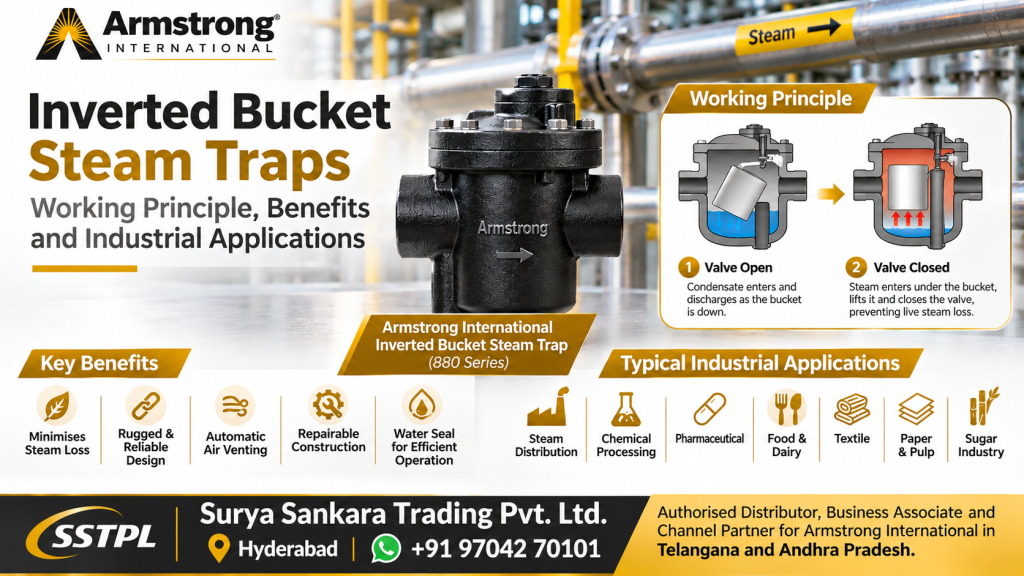
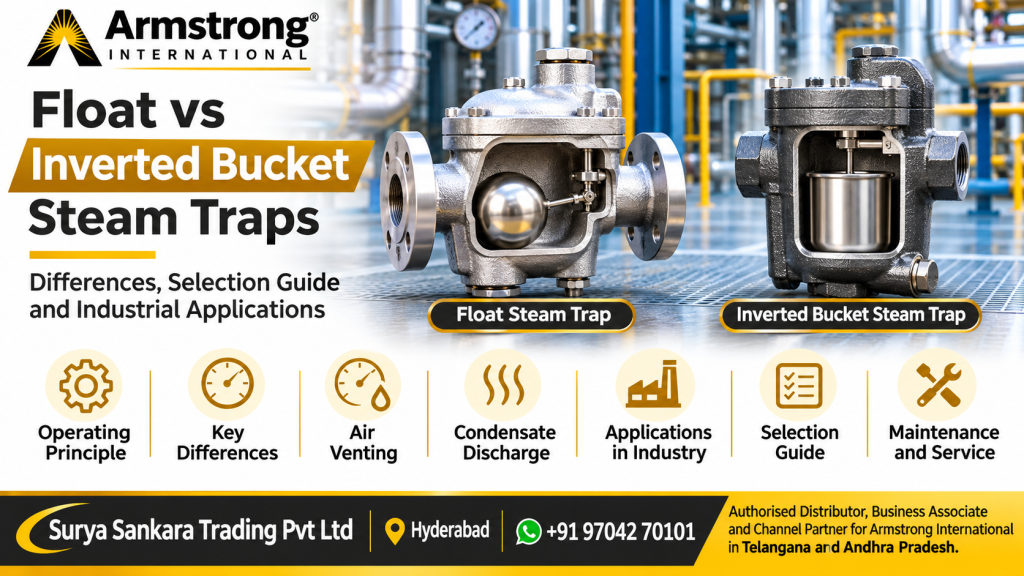
Inverted Bucket Steam Traps: Working Principle, Benefits and Industrial Applications. An inverted bucket steam trap is a mechanical device that removes condensate from industrial steam systems while limiting the escape of live steam. Its operating principle is based on the difference in density between steam and water. This simple mechanism makes it relevant to steam distribution networks, process heating equipment and other applications requiring reliable condensate drainage. Condensate backup can reduce heat transfer and increase water hammer risk; live steam leakage raises operating costs. Understanding the mechanism helps engineers select and maintain equipment. Surya Sankara Trading Pvt. Ltd. (SSTPL) is an Authorised Distributor, Business Associate and Channel Partner for Armstrong International in Telangana and Andhra Pradesh. From Hyderabad, SSTPL supports industrial enquiries for Armstrong International steam and condensate solutions. What Is an Inverted Bucket Steam Trap? An inverted bucket steam trap contains an upside-down bucket connected to a discharge valve through a lever mechanism. Steam collecting underneath the bucket makes it buoyant, raising it and closing the valve. As steam inside the bucket condenses or escapes slowly through a vent, the bucket sinks and opens the valve to release condensate. The trap usually discharges in cycles, although condensate can enter between them. Armstrong International describes this as continuous drainage with intermittent discharge. The water surrounding the valve outlet forms a seal that helps keep live steam from escaping during normal operation. How Does an Inverted Bucket Steam Trap Work? Step 1: Start-Up and Condensate Entry At start-up, the bucket is normally down and the discharge valve is open. Air and initial condensate enter the trap, and condensate passes through the open outlet. Proper priming establishes the water seal needed for normal functioning. Step 2: Steam Enters Beneath the Bucket Steam flows underneath the inverted bucket and becomes trapped there. Because the steam-filled bucket is more buoyant than the surrounding condensate, it rises. The lever mechanism then closes the discharge valve, preventing unnecessary steam discharge. Step 3: Air and Steam Vent Through a Small Opening A small hole near the bucket’s top allows air and other non-condensable gases to escape. Some trapped steam passes through this hole and condenses. High start-up air loads require assessment because vent capacity is limited. Step 4: Bucket Sinks and Condensate Discharges As steam within the bucket condenses and buoyancy decreases, the bucket sinks. The lever opens the valve and the accumulated condensate is discharged through the outlet. Incoming steam eventually raises the bucket again, repeating the cycle. Key point: Intermittent outlet discharge is normal for this technology; it does not automatically indicate a malfunction. Main Benefits of Armstrong International Inverted Bucket Steam Traps Reduced live steam leakage: The water-sealed discharge orifice helps prevent live steam from reaching the outlet when the trap operates correctly. Durable mechanical arrangement: The free-floating lever mechanism used in relevant Armstrong International designs has no fixed pivots, reducing certain friction and wear points. Resistance to dirt-related problems: A top-positioned discharge mechanism and periodic opening can help purge suspended particles, although good steam-system cleanliness remains essential. Air and carbon dioxide venting: A vent in the bucket allows these gases to leave the trap without waiting for condensate to cool substantially. Tolerance of challenging operation: Relevant models are designed to withstand demanding industrial conditions, including some water hammer exposure. They are not immune to poor piping design or severe pressure shocks. Repairable configurations: Some cast-iron Armstrong International models have replaceable internal parts, potentially reducing whole-unit replacement costs. Repairability must be confirmed for the exact model. Benefits depend on model selection, installation and maintenance. Armstrong International 880 Series: An Industrial Example The Armstrong International 880 Series is a cast-iron inverted bucket steam trap family intended for horizontal installation. Manufacturer information describes an integral strainer, a free-floating stainless steel operating mechanism, automatic venting and a discharge orifice positioned near the top of the body. Models 880, 881, 882 and 883 vary in capacity, pressure rating and connections; confirm the specific model against current manufacturer data. Read our Armstrong International Inverted Bucket Trap product page for product information and to start an enquiry. Industrial Applications of Inverted Bucket Steam Traps Steam Distribution and Drip Legs Steam mains require drainage points to remove condensate formed through heat loss. A suitable inverted bucket steam trap can discharge this condensate and help protect the distribution system when matched to the actual operating conditions. Textile and Paper Manufacturing Textile processing and paper production use steam for drying, finishing and related operations. Inverted bucket technology may be suitable for selected steam drainage duties, but rotating dryers and controlled heating systems require careful arrangement and pressure-differential checks. Food Processing, Dairy and Sugar Plants Steam is used for heating, cooking and process utilities. Inverted bucket steam traps can serve appropriate steam distribution and equipment drainage applications. Variable process loads may sometimes call for alternative trap types or pumping solutions. Pharmaceutical and Chemical Industries These facilities require reliable steam distribution and process heating. Material compatibility, pressure ratings and air-removal requirements should be reviewed. Clean-steam or hygienic product-contact duties may require specialised equipment rather than an ordinary industrial steam trap. How to Select the Right Inverted Bucket Steam Trap Before requesting a quotation, prepare these operating details: Steam pressure at the trap inlet, including the lowest expected operating pressure Condensate return pressure and any elevation or back-pressure effects Normal and start-up condensate load in kg/h Maximum design pressure and temperature Application type: steam main, tracing, process heater or equipment drain Required connection size, connection standard and installation orientation Expected dirt, corrosion, freezing and maintenance conditions A useful first check is available pressure differential = inlet pressure minus outlet pressure. The selected trap must have enough discharge capacity at the actual minimum differential pressure, including any applicable sizing allowance. Do not size a steam trap solely by pipe diameter. Installation, Testing and Common Problems Incorrect orientation, an inadequate water seal, dirt accumulation, excessive differential pressure and unexpected return-line back pressure can all affect trap operation. In some designs, a sudden pressure drop may cause loss

Steam Trap Selection
Blog

Steam Trap Selection Guide | Armstrong International

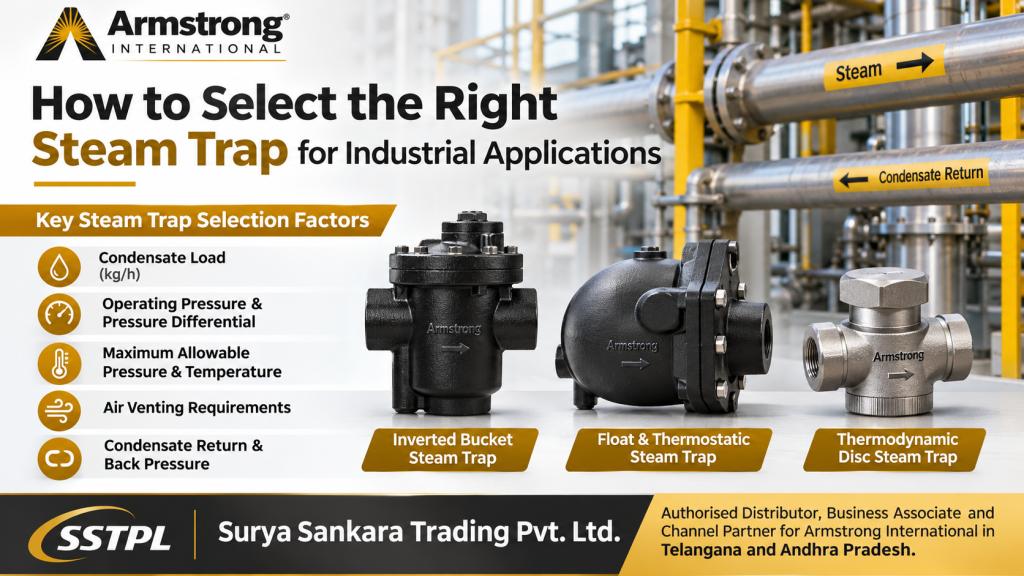
How to Select the Right Steam Trap for Industrial Applications. Steam Trap Selection guide is an important engineering decision that affects energy efficiency, condensate drainage, equipment reliability and operating costs in industrial steam systems. Whether steam is used for heating, drying, sterilisation or manufacturing processes, choosing the correct steam trap helps minimise unnecessary steam losses and maintain efficient heat transfer. Industrial steam traps must be selected according to operating pressure, condensate load, pressure differential, air venting requirements and equipment applications. Incorrect selection may result in steam leakage, condensate accumulation, water hammer and production interruptions. Armstrong International offers a comprehensive range of industrial steam traps for different operating requirements. Surya Sankara Trading Pvt. Ltd. is an Authorised Distributor, Business Associate and Channel Partner for Armstrong International in Telangana and Andhra Pradesh. Based in Hyderabad, we support industrial customers with product enquiries, application discussions and technical coordination. What Is a Steam Trap and Why Is Proper Selection Important? A steam trap is an automatic valve designed to discharge condensate and non-condensable gases from a steam system while minimising the loss of live steam. When steam transfers heat to industrial equipment, some of it condenses into water. This condensate must be removed to maintain effective heating and system reliability. An incorrectly selected steam trap can create several operational problems: Live steam leakage and increased fuel consumption Condensate accumulation and reduced heat transfer Water hammer and possible pipeline damage Poor temperature control Increased maintenance costs Unexpected process interruptions Proper steam trap selection involves balancing discharge capacity, operating conditions, equipment requirements and long-term reliability. Types of Industrial Steam Traps Different steam trap technologies use different operating principles. Understanding these differences is essential before choosing a suitable model. 1. Inverted Bucket Steam Traps Inverted bucket steam traps operate using the buoyancy of an inverted bucket inside the trap body. As steam enters, the bucket rises and closes the discharge valve. When steam condenses and the bucket loses buoyancy, the valve opens to discharge condensate. Armstrong International inverted bucket steam traps are widely used in industrial steam distribution and suitable process heating applications. Important characteristics include intermittent discharge, a water seal that helps restrict live steam loss and mechanical construction designed for demanding service conditions. Related product: Armstrong International Inverted Bucket Steam Trap 2. Float and Thermostatic Steam Traps Float and thermostatic (F&T) steam traps use a float mechanism to control condensate discharge and a thermostatic element to release air. These traps can discharge condensate continuously as it forms. They are commonly considered for process heating applications with varying condensate loads, particularly where efficient air removal and continuous drainage are important. 3. Thermodynamic Disc Steam Traps Thermodynamic disc steam traps operate through pressure and flow changes associated with steam and condensate. They are compact and may be suitable for selected steam main drainage and steam tracing applications. Performance depends on minimum operating pressure, back pressure, discharge conditions and the manufacturer’s design. 4. Thermostatic and Bimetallic Steam Traps Thermostatic steam traps respond to temperature differences between steam and condensate. Depending on the design, they may discharge condensate after it cools below saturation temperature. Bimetallic steam traps use metal elements that respond to temperature changes and are suitable for selected steam tracing and high-temperature applications. These technologies must be selected carefully where condensate backup or subcooling could affect process performance. Key Factors to Consider During Steam Trap Selection 1. Condensate Load Condensate load is the quantity of water formed when steam transfers heat to equipment. It is commonly expressed in kilograms per hour (kg/h). Steam traps must have sufficient discharge capacity to handle expected operating and start-up condensate loads. For example, a process heat exchanger may experience significantly higher condensate production during initial heating than during steady operation. Equipment duty, steam consumption and start-up conditions must therefore be evaluated before sizing. 2. Operating Pressure and Pressure Differential Pressure differential is the difference between steam trap inlet pressure and downstream condensate return pressure. Pressure Differential = Trap Inlet Pressure − Trap Outlet Pressure For example, if the inlet pressure is 5 barg and the outlet pressure is 1 barg, the available pressure differential is approximately 4 bar, before considering other system effects. Actual differential pressure may vary because of control valves, condensate return pressure, friction losses or condensate lifting requirements. A steam trap must provide adequate capacity under the expected operating pressure differential. 3. Maximum Allowable Pressure and Temperature The steam trap body and internal components must withstand the maximum pressure and temperature conditions of the installation. Maximum allowable pressure is not the same as operating pressure differential. Buyers should verify the proposed model’s pressure and temperature ratings against manufacturer documentation. 4. Safety or Experience Factor Steam trap sizing may require an application-specific safety factor to accommodate variable loads, operating conditions and system characteristics. Armstrong International’s selection guidelines explain that the appropriate factor varies considerably according to the equipment and installation. Applying an excessive factor can also create problems, including unnecessary equipment costs and additional steam loss if an oversized trap fails. The correct factor should be determined using manufacturer guidance. 5. Air Venting Requirements Air and other non-condensable gases can reduce heat transfer efficiency. Applications such as process heating equipment may require effective air removal during start-up. Some steam trap designs provide more effective start-up air venting than others. Air venting capability should therefore be considered alongside condensate discharge capacity. 6. Condensate Return and Back Pressure Condensate may discharge into an atmospheric drain or a pressurised return system. High back pressure reduces the effective differential pressure available for drainage. For installations with modulating steam control valves, steam pressure may fall below return pressure, creating a stall condition. In such cases, a conventional steam trap alone may not provide adequate drainage. A properly engineered pump-trap arrangement may be required. Example of Industrial Steam Trap Sizing Consider an industrial heating application with the following preliminary requirements: Selection parameter Example value Operating steam pressure 5 barg Condensate return pressure 1 barg Normal condensate load 200 kg/h Illustrative sizing factor 2:1 Preliminary

Scroll to Top