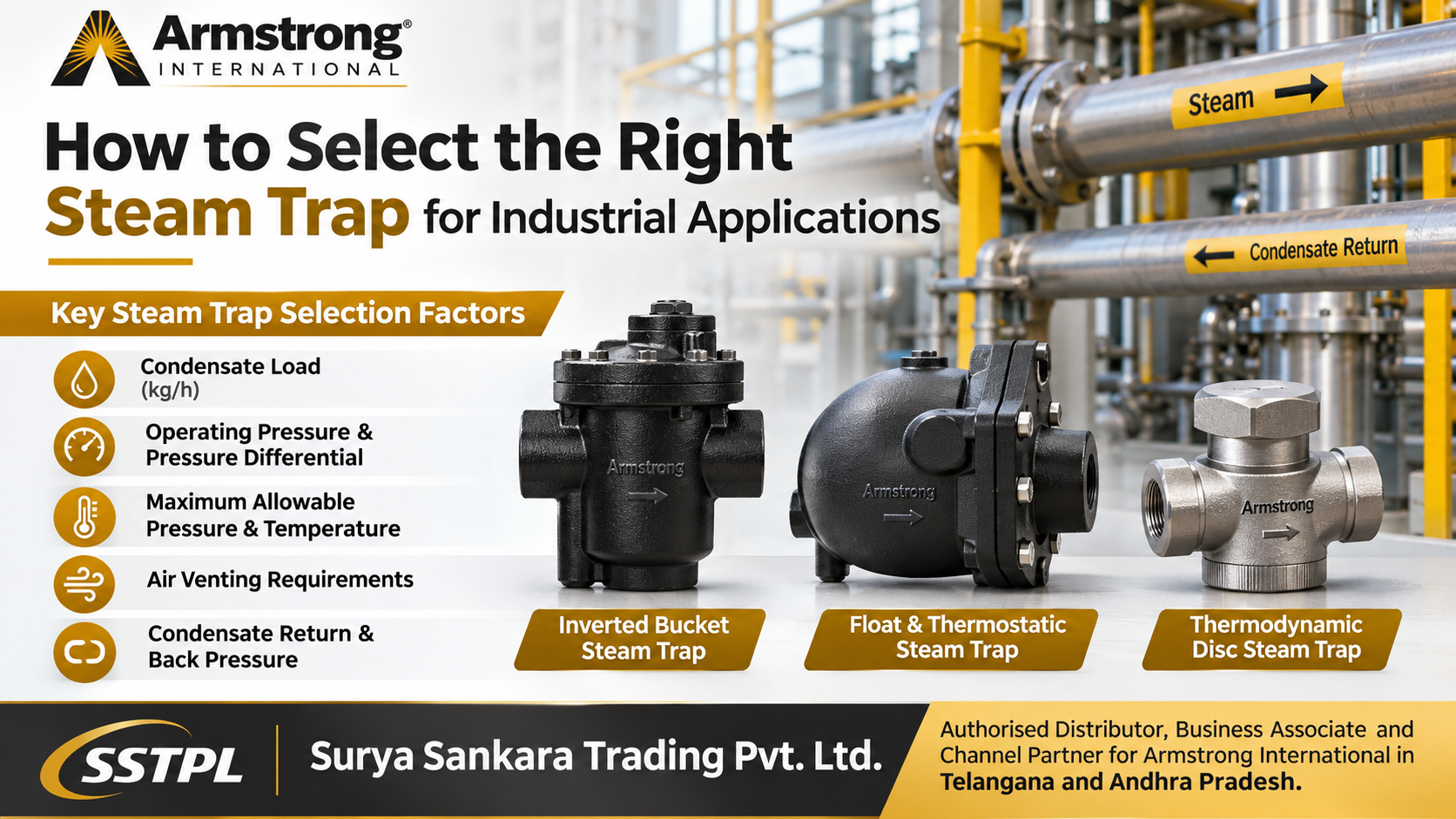
How to Select the Right Steam Trap for Industrial Applications. Steam Trap Selection guide is an important engineering decision that affects energy efficiency, condensate drainage, equipment reliability and operating costs in industrial steam systems. Whether steam is used for heating, drying, sterilisation or manufacturing processes, choosing the correct steam trap helps minimise unnecessary steam losses and maintain efficient heat transfer.
Industrial steam traps must be selected according to operating pressure, condensate load, pressure differential, air venting requirements and equipment applications. Incorrect selection may result in steam leakage, condensate accumulation, water hammer and production interruptions.
Armstrong International offers a comprehensive range of industrial steam traps for different operating requirements.
Surya Sankara Trading Pvt. Ltd. is an Authorised Distributor, Business Associate and Channel Partner for Armstrong International in Telangana and Andhra Pradesh. Based in Hyderabad, we support industrial customers with product enquiries, application discussions and technical coordination.
What Is a Steam Trap and Why Is Proper Selection Important?
A steam trap is an automatic valve designed to discharge condensate and non-condensable gases from a steam system while minimising the loss of live steam.
When steam transfers heat to industrial equipment, some of it condenses into water. This condensate must be removed to maintain effective heating and system reliability.
An incorrectly selected steam trap can create several operational problems:
- Live steam leakage and increased fuel consumption
- Condensate accumulation and reduced heat transfer
- Water hammer and possible pipeline damage
- Poor temperature control
- Increased maintenance costs
- Unexpected process interruptions
Proper steam trap selection involves balancing discharge capacity, operating conditions, equipment requirements and long-term reliability.
Types of Industrial Steam Traps
Different steam trap technologies use different operating principles. Understanding these differences is essential before choosing a suitable model.
1. Inverted Bucket Steam Traps
Inverted bucket steam traps operate using the buoyancy of an inverted bucket inside the trap body.
As steam enters, the bucket rises and closes the discharge valve. When steam condenses and the bucket loses buoyancy, the valve opens to discharge condensate.
Armstrong International inverted bucket steam traps are widely used in industrial steam distribution and suitable process heating applications.
Important characteristics include intermittent discharge, a water seal that helps restrict live steam loss and mechanical construction designed for demanding service conditions.
Related product: Armstrong International Inverted Bucket Steam Trap
2. Float and Thermostatic Steam Traps
Float and thermostatic (F&T) steam traps use a float mechanism to control condensate discharge and a thermostatic element to release air.
These traps can discharge condensate continuously as it forms.
They are commonly considered for process heating applications with varying condensate loads, particularly where efficient air removal and continuous drainage are important.
3. Thermodynamic Disc Steam Traps
Thermodynamic disc steam traps operate through pressure and flow changes associated with steam and condensate.
They are compact and may be suitable for selected steam main drainage and steam tracing applications.
Performance depends on minimum operating pressure, back pressure, discharge conditions and the manufacturer’s design.
4. Thermostatic and Bimetallic Steam Traps
Thermostatic steam traps respond to temperature differences between steam and condensate.
Depending on the design, they may discharge condensate after it cools below saturation temperature.
Bimetallic steam traps use metal elements that respond to temperature changes and are suitable for selected steam tracing and high-temperature applications.
These technologies must be selected carefully where condensate backup or subcooling could affect process performance.
Key Factors to Consider During Steam Trap Selection
1. Condensate Load
Condensate load is the quantity of water formed when steam transfers heat to equipment.
It is commonly expressed in kilograms per hour (kg/h).
Steam traps must have sufficient discharge capacity to handle expected operating and start-up condensate loads.
For example, a process heat exchanger may experience significantly higher condensate production during initial heating than during steady operation.
Equipment duty, steam consumption and start-up conditions must therefore be evaluated before sizing.
2. Operating Pressure and Pressure Differential
Pressure differential is the difference between steam trap inlet pressure and downstream condensate return pressure.
Pressure Differential = Trap Inlet Pressure − Trap Outlet Pressure
For example, if the inlet pressure is 5 barg and the outlet pressure is 1 barg, the available pressure differential is approximately 4 bar, before considering other system effects.
Actual differential pressure may vary because of control valves, condensate return pressure, friction losses or condensate lifting requirements.
A steam trap must provide adequate capacity under the expected operating pressure differential.
3. Maximum Allowable Pressure and Temperature
The steam trap body and internal components must withstand the maximum pressure and temperature conditions of the installation.
Maximum allowable pressure is not the same as operating pressure differential.
Buyers should verify the proposed model’s pressure and temperature ratings against manufacturer documentation.
4. Safety or Experience Factor
Steam trap sizing may require an application-specific safety factor to accommodate variable loads, operating conditions and system characteristics.
Armstrong International’s selection guidelines explain that the appropriate factor varies considerably according to the equipment and installation.
Applying an excessive factor can also create problems, including unnecessary equipment costs and additional steam loss if an oversized trap fails.
The correct factor should be determined using manufacturer guidance.
5. Air Venting Requirements
Air and other non-condensable gases can reduce heat transfer efficiency.
Applications such as process heating equipment may require effective air removal during start-up.
Some steam trap designs provide more effective start-up air venting than others.
Air venting capability should therefore be considered alongside condensate discharge capacity.
6. Condensate Return and Back Pressure
Condensate may discharge into an atmospheric drain or a pressurised return system.
High back pressure reduces the effective differential pressure available for drainage.
For installations with modulating steam control valves, steam pressure may fall below return pressure, creating a stall condition.
In such cases, a conventional steam trap alone may not provide adequate drainage. A properly engineered pump-trap arrangement may be required.
Example of Industrial Steam Trap Sizing
Consider an industrial heating application with the following preliminary requirements:
| Selection parameter | Example value |
|---|---|
| Operating steam pressure | 5 barg |
| Condensate return pressure | 1 barg |
| Normal condensate load | 200 kg/h |
| Illustrative sizing factor | 2:1 |
| Preliminary required capacity | 400 kg/h |
The preliminary requirement is calculated as:
200 kg/h × 2 = 400 kg/h
The selected trap would need to discharge the required capacity at the applicable differential pressure, while satisfying maximum pressure, temperature and other operating requirements.
Note: This is an illustrative calculation, not a universal sizing rule. The actual safety factor and equipment selection must be confirmed against Armstrong International’s application-specific capacity charts and engineering guidance.
Steam Trap Selection for Different Industrial Applications
Pharmaceutical Manufacturing
Pharmaceutical plants use steam for process heating, sterilisation-related utilities and other applications.
Reliable condensate drainage, appropriate materials and effective air removal are important considerations. Clean steam applications may require specialised equipment and additional quality requirements.
Food Processing and Dairy Industries
Food and dairy manufacturing facilities use steam for cooking, heating and processing equipment.
Steam trap selection must consider condensate load fluctuations, start-up conditions and the heating equipment’s operating requirements.
Textile Industries
Textile manufacturing uses steam for dyeing, drying, finishing and other processes.
Appropriate steam traps help maintain condensate drainage and reliable heating performance in suitable equipment.
Chemical and Petrochemical Industries
Chemical plants use steam for process heating, tracing and industrial utilities.
Steam trap selection should consider operating pressure, corrosion exposure, temperature requirements and the nature of the process.
Paper and Sugar Industries
Paper mills use steam for drying and heating, while sugar manufacturing facilities use steam in evaporation and processing operations.
Condensate handling, changing process loads and equipment arrangement can influence the appropriate steam trapping technology.
Common Steam Trap Selection Mistakes
Industrial plants should avoid the following mistakes:
- Selecting by pipe size alone: Connection size does not establish discharge capacity.
- Ignoring back pressure: Inadequate differential pressure can prevent proper condensate drainage.
- Overlooking start-up loads: A trap sized only for steady operation may perform poorly during initial heating.
- Using one trap for multiple independent equipment drains: Group trapping can create drainage problems when equipment operates at different pressures.
- Ignoring installation requirements: Incorrect orientation, missing strainers or poor drainage arrangements may cause operational failures.
Final selection and installation should follow the applicable manufacturer’s technical instructions and plant safety procedures.
Armstrong International Steam Trap in Telangana and Andhra Pradesh
Surya Sankara Trading Pvt. Ltd., established in 2011, supports industrial customers seeking Armstrong International steam traps and related steam and condensate solutions.
Telangana: Hyderabad, Patancheru, Sangareddy, Medchal, Jeedimetla, Warangal and other industrial areas.
Andhra Pradesh: Visakhapatnam, Vijayawada, Kakinada, Sri City, Tirupati and other industrial areas.
Customers can contact SSTPL for Armstrong International product enquiries, model identification, technical coordination and quotation requests.
Related products include the Armstrong International Steam Trap Tester and Steam Pump Trap Package.
Frequently Asked Questions About Steam Trap Selection
1. How do I select the correct steam trap for industrial applications?
Select a steam trap based on the application, condensate load, steam inlet pressure, back pressure, operating temperature, air venting and installation requirements. Different steam trap designs suit different duties. Manufacturer capacity charts and engineering guidance should be used to verify the final selection rather than relying only on pipe connection size.
2. Which steam trap is suitable for steam distribution lines?
Inverted bucket and thermodynamic disc steam traps are commonly considered for suitable steam distribution drainage applications. The preferred type depends on operating pressure, condensate load, air venting, installation conditions and maintenance requirements. The final choice should follow the application-specific recommendations published by Armstrong International.
3. What is the difference between inverted bucket and float and thermostatic steam traps?
Inverted bucket steam traps typically discharge condensate intermittently using a buoyancy-operated mechanical mechanism. Float and thermostatic traps generally provide continuous condensate drainage and separate thermostatic air venting. Both can be effective when correctly selected, but their suitability depends on the industrial application’s operating characteristics.
4. Can incorrect steam trap sizing increase energy consumption?
Yes. Incorrect sizing or selection can contribute to condensate backup, reduced heating efficiency and operational problems. An unnecessarily oversized trap may also increase potential steam losses if it fails open. Correct sizing, installation and regular inspection help maintain efficient steam and condensate system performance.
5. Who is an authorised distributor for Armstrong International steam traps in Telangana and Andhra Pradesh?
Surya Sankara Trading Pvt. Ltd., based in Hyderabad, is an Authorised Distributor, Business Associate and Channel Partner for Armstrong International in Telangana and Andhra Pradesh. The company supports industrial customers with Armstrong International steam trap product enquiries, application discussions and technical coordination.
Conclusion: Choose the Right Steam Trap for Your Industrial Plant
Effective steam trap selection requires more than choosing a familiar brand or matching a pipe connection size. Condensate load, pressure differential, operating conditions, air venting and the equipment’s application must all be considered.
Armstrong International provides multiple steam trap technologies to address different industrial requirements.
For steam trap product selection discussions and quotation enquiries in Telangana and Andhra Pradesh, contact:
Surya Sankara Trading Pvt. Ltd.
Prashant Nagar, IDA Kukatpally, Hyderabad – 500072, Telangana, India.
Phone / WhatsApp: +91 97042 70101
Email: suryasankaratraders@gmail.com
Website: armstrong.suryasankara.in
Contact Us: Send an Enquiry
Request a quotation: Share your plant location, steam pressure, condensate load, existing steam trap model and application requirements for a product discussion.