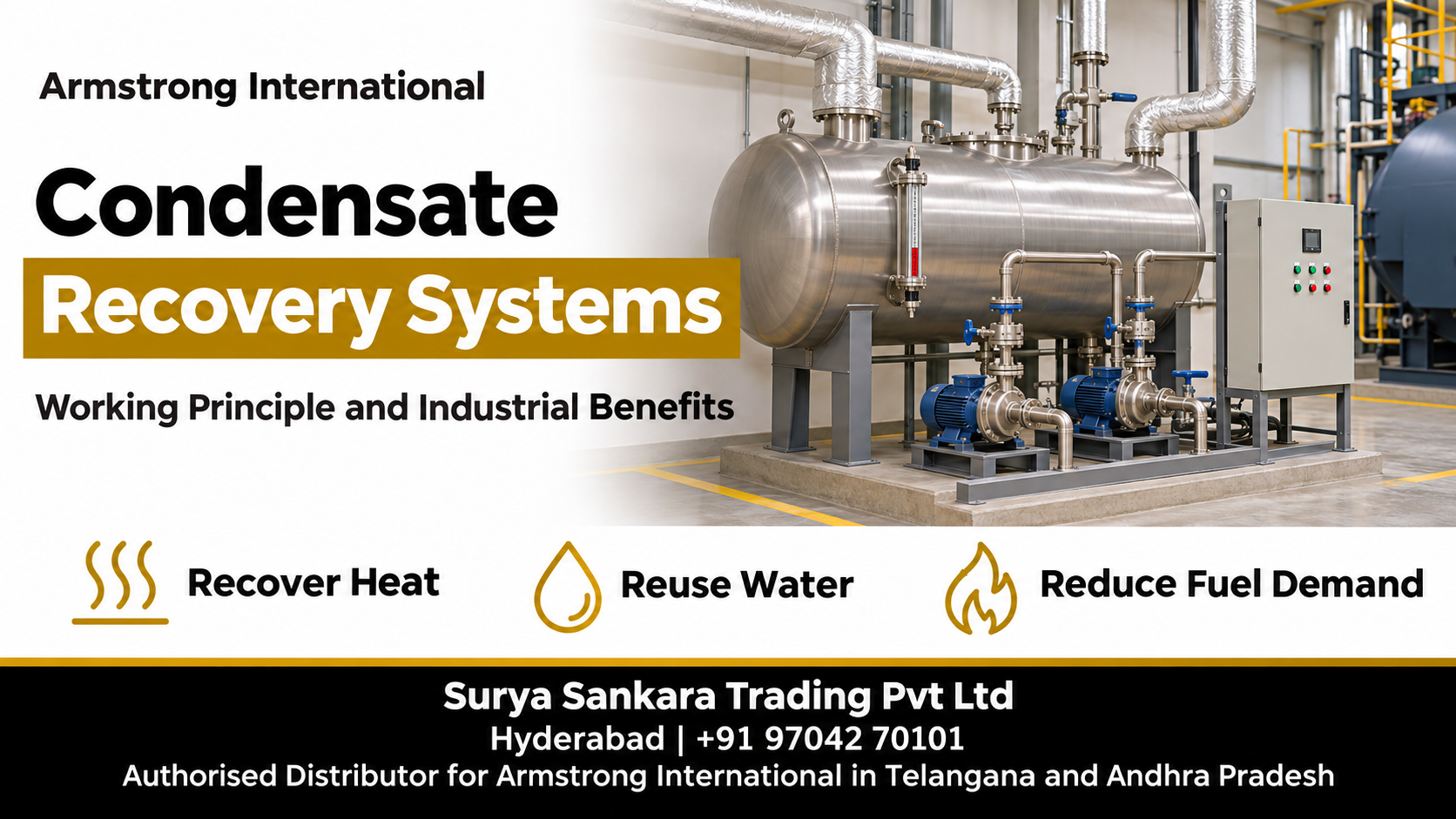
Condensate Recovery Systems: Working Principle and Industrial Benefits. A Condensate Recovery System plays an important role in improving industrial steam efficiency by collecting hot condensate and returning it for reuse in the boiler feedwater system. Industrial plants that discharge recoverable condensate unnecessarily may lose valuable thermal energy, treated water and boiler chemicals.
In pharmaceutical, textile, food processing, chemical, paper and sugar industries, steam is widely used for heating, drying and other manufacturing operations. Once steam transfers its heat, it becomes condensate that may still contain significant recoverable energy.
Armstrong International offers advanced condensate management technologies, including steam pump trap packages, mechanical pumping systems and related steam solutions.
Surya Sankara Trading Pvt Ltd is an Authorised Distributor, Business Associate and Channel Partner for Armstrong International in Telangana and Andhra Pradesh. Based in Hyderabad, the company supports industrial customers with product enquiries, application discussions and technical coordination.
What Is a Condensate Recovery System?
A condensate recovery system collects water formed when steam releases its heat to industrial equipment.
Instead of discharging suitable condensate into drains, the system returns it to a condensate collection tank, boiler feedwater system or another designated recovery point.
Recovered condensate can provide two valuable resources:
- Thermal energy: Hot condensate requires less additional heating than cold make-up water.
- Treated water: Suitable condensate can reduce the quantity of fresh water and treatment chemicals needed for boiler operation.
The amount of energy recovered depends on condensate temperature, flow rate, recovery efficiency and plant operating conditions.
Condensate quality must be verified before reuse because contaminated condensate can damage boiler systems.
How Does a Condensate Recovery System Work?
Industrial condensate recovery involves several stages.
1. Steam Transfers Heat to Equipment
Steam from the boiler enters industrial equipment such as heat exchangers, heating coils, dryers or jacketed vessels.
As steam releases latent heat, it condenses into hot water.
2. Steam Traps Discharge Condensate
Correctly selected steam traps discharge condensate while restricting unnecessary live steam losses.
Armstrong International offers different steam trap technologies for industrial operating conditions, including inverted bucket steam traps.
3. Condensate Enters the Return System
Discharged condensate flows through suitable return piping toward a collection receiver or recovery system.
Depending on pressure and piping arrangement, condensate may move by gravity or require pumping.
4. Condensate Is Collected and Pumped
Where gravity drainage is insufficient, a condensate recovery pump or pressure-operated pump trap can move condensate against elevation or return-line pressure.
Some Armstrong International pumping technologies operate using steam or compressed gas rather than electricity.
5. Recovered Condensate Is Reused
Acceptable condensate can be returned to the boiler feedwater system, subject to water quality, temperature and boiler operating requirements.
This reduces the need for fresh make-up water and the associated heating energy.
Main Components of a Condensate Recovery System
An industrial recovery installation may contain:
| Component | Primary function |
|---|---|
| Steam traps | Remove condensate while limiting live steam discharge |
| Condensate return piping | Transport condensate to a recovery point |
| Condensate receiver | Collect condensate before pumping |
| Condensate pump or pump trap | Move condensate against elevation or back pressure |
| Check valves | Prevent undesirable reverse flow |
| Flash steam recovery equipment | Recover useful flash steam where feasible |
| Monitoring instruments | Measure operating conditions and system performance |
The actual equipment arrangement depends on the process, recovery pressure and plant layout.
Key Industrial Benefits of Condensate Recovery Systems
1. Reduced Fuel Consumption
Recovered hot condensate requires less energy to reach boiler feedwater conditions compared with cold make-up water.
This can reduce boiler heating requirements and fuel consumption.
2. Lower Water Consumption
Returning suitable condensate decreases the need for fresh boiler make-up water.
This is especially valuable for industrial plants seeking better water resource management.
3. Reduced Water Treatment Costs
Boiler make-up water normally requires treatment to control scale, corrosion and other operating problems.
Recovering acceptable condensate can reduce the volume of water requiring treatment and associated chemical consumption.
4. Improved Steam System Efficiency
Effective condensate removal helps steam-heated equipment operate efficiently while returning recoverable heat to the boiler system.
5. Reduced Wastewater Discharge
Reusing condensate can decrease the volume of hot water discharged to drains or wastewater treatment systems.
Environmental and disposal benefits depend on the existing plant arrangements.
6. Support for Energy Conservation
Condensate recovery is an important part of broader steam system energy management.
Actual savings should be calculated from measured plant data rather than assumed percentages.
Armstrong International Condensate Recovery Solutions
Armstrong International provides several technologies for industrial condensate management.
Steam Pump Trap Packages
Armstrong International engineered pump trap packages are designed for suitable condensate drainage and recovery applications.
These packages can incorporate pumping equipment, receivers, check valves, isolation valves, piping and monitoring components.
They may help simplify installation and condensate handling in demanding industrial applications.
Related product: Armstrong International Steam Pump Trap Package
Mechanical Pumping Traps
Armstrong International offers non-electric pumping trap technologies for moving condensate from low-pressure, low-elevation or vacuum systems to higher-pressure recovery points.
For example, its EPT Series includes pressure-operated pumping traps designed for selected high-temperature condensate applications.
Steam Trap and Pump Combinations
Armstrong International Double Duty® technologies combine steam trapping and pumping functions for suitable process heat exchangers and heating coils.
These arrangements can be useful where modulating steam pressure creates condensate drainage difficulties.
Model availability, operating limits and system suitability must be confirmed against manufacturer documentation.
How to Select the Right Condensate Recovery System
Before selecting a condensate recovery system, engineers should evaluate:
- Total condensate generation rate in kg/h
- Normal and maximum condensate temperature
- Steam and condensate return pressures
- Required pumping elevation
- Available filling head for pumping equipment
- Condensate quality and contamination risk
- Flash steam generation and recovery opportunities
- Pipeline routing and pressure losses
- Equipment operating hours and load variations
- Boiler feedwater and water treatment requirements
For steam-heated equipment with modulating control valves, stall conditions deserve particular attention.
A stall can occur when pressure inside the steam-heated equipment becomes insufficient to overcome condensate return back pressure.
In such situations, replacing the steam trap alone may not resolve the problem. An appropriately engineered pump-trap system may be required.
Industrial Applications of Condensate Recovery
Pharmaceutical Industries
Pharmaceutical manufacturing facilities use steam for process heating and industrial utilities. Suitable condensate recovery arrangements can improve utility efficiency while maintaining necessary water quality controls.
Food Processing, Dairy and Breweries
Steam is used for cooking, heating, cleaning-related utilities and other processing operations. Condensate recovery may reduce water and energy requirements where reuse is appropriate.
Textile Industries
Textile plants use steam for dyeing, washing, drying and finishing operations. Hot condensate recovery can support energy conservation in suitable process heating systems.
Chemical Industries
Chemical manufacturing facilities operate steam-heated reactors, exchangers and processing equipment. Condensate recovery must consider possible contamination and process operating conditions.
Paper and Pulp Industries
Paper mills use substantial steam energy for drying and heating. Effective condensate removal and recovery can contribute to improved overall thermal efficiency.
Sugar Industries
Sugar plants operate extensive steam networks for heating and evaporation processes. Recovering suitable condensate can help reduce boiler make-up water and associated energy requirements.
Common Condensate Recovery Problems
Industrial plants should investigate these common problems:
Excessive back pressure: Can restrict steam trap discharge and cause condensate accumulation.
Undersized return piping: May create excessive pressure drop and unstable operation.
Flash steam handling problems: Hot condensate exposed to lower pressure can generate flash steam, requiring appropriate system design.
Pump cavitation: Some conventional electric pumping arrangements may experience difficulties when handling very hot condensate.
Condensate contamination: Process leaks can introduce unsuitable chemicals or other contaminants into return systems.
Poor steam trap maintenance: Leaking or blocked traps can reduce system efficiency and reliability.
Regular inspection, correct engineering selection and appropriate monitoring help address these problems.
For manufacturer guidance on recovering heat and reusing condensate as boiler feedwater, see Armstrong International’s Steam & Condensate Solutions.