How to Reduce Steam Losses in Industrial Plants: Practical Energy-Saving Solutions. Learning how to reduce steam losses in industrial plants is essential for improving energy efficiency, controlling fuel costs and maintaining reliable manufacturing operations. Steam is widely used in pharmaceutical, food processing, textile, chemical, paper and sugar industries for heating, drying, sterilisation-related utilities and other processes.
However, leaking steam pipelines, malfunctioning steam traps, damaged insulation and inefficient condensate recovery can lead to avoidable energy consumption.
Reducing steam losses requires a systematic approach that evaluates steam generation, distribution, utilisation and condensate return.
Armstrong International offers industrial steam traps, steam trap testing equipment, pressure reducing valves, steam flow meters and condensate management technologies that support efficient steam system operation.
Surya Sankara Trading Pvt Ltd is an Authorised Distributor, Business Associate and Channel Partner for Armstrong International in Telangana and Andhra Pradesh. Based in Hyderabad and established in 2011, the company supports industrial customers with steam and thermal utility product enquiries and technical coordination.
What Causes Steam Losses in Industrial Plants?
Steam losses occur when useful steam escapes from the system or when thermal energy is wasted before reaching the intended process.
The main causes include:
- Leaking steam pipes, valves and flanges
- Failed-open or leaking steam traps
- Uninsulated steam distribution pipelines
- Excessive or uncontrolled steam venting
- Inefficient condensate recovery
- Inappropriate operating pressures
- Poor steam system maintenance
- Unnecessary steam consumption during idle periods
It is important to distinguish between live steam leakage and heat loss.
Live steam leakage represents an actual loss of steam mass from the system. Heat loss occurs when thermal energy escapes through piping, equipment surfaces or other components, increasing the steam required to maintain process conditions.
Both can increase industrial energy costs.
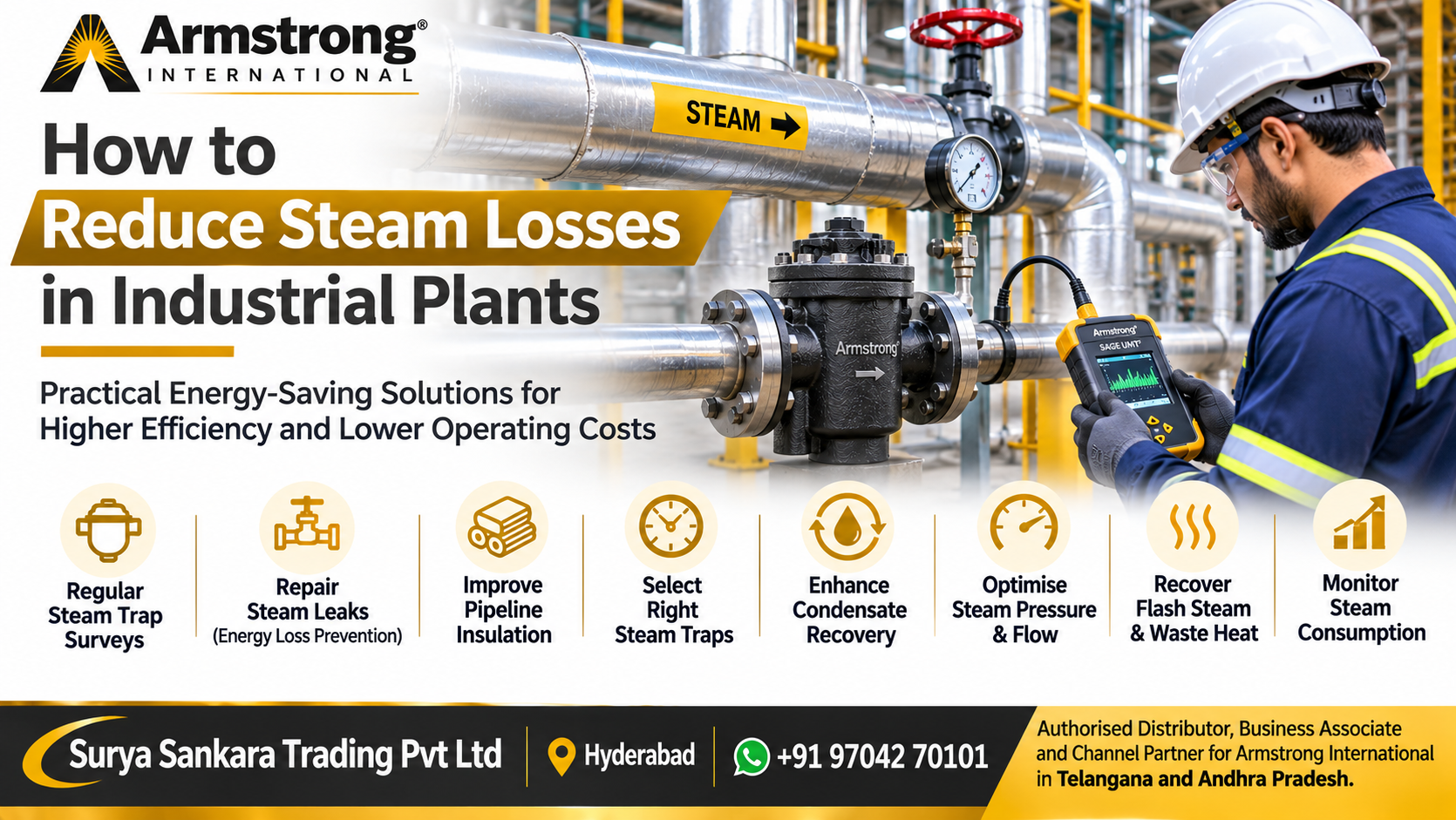
8 Practical Ways to Reduce Steam Losses in Industrial Plants
1. Conduct Regular Steam Trap Surveys
Steam traps remove condensate and non-condensable gases while limiting live steam discharge.
A malfunctioning steam trap may leak live steam continuously or prevent adequate condensate drainage.
Regular steam trap surveys help maintenance teams identify faulty equipment and prioritise corrective work.
Armstrong International offers the SAGE UMT® Automatic Steam Trap Tester, which uses acoustic and infrared temperature measurements to evaluate steam trap operating conditions.
Systematic surveys can support:
- Detection of leaking or blocked steam traps
- Better maintenance planning
- Reduction of avoidable steam losses
- Improved condensate drainage
- More reliable steam system performance
Related product: Armstrong International Steam Trap Tester
2. Repair Steam Pipeline and Valve Leaks
Steam leaks can occur at pipe joints, valve stems, flanges, gaskets and equipment connections.
Even relatively small leaks may create substantial cumulative losses when a plant operates continuously.
Industrial maintenance teams should establish regular inspections to locate visible and suspected steam leakage points.
Leak assessment should consider operating pressure, location, severity and safety risks.
Corrective actions may involve approved gasket replacement, valve repair or pipeline maintenance.
All repairs must follow proper isolation, depressurisation and plant safety procedures.
3. Improve Steam Pipeline Insulation
Uninsulated steam pipelines release thermal energy into the surrounding environment.
Damaged, missing or wet insulation can also increase heat losses from steam distribution systems.
Effective insulation helps reduce heat transfer to the surroundings and supports more efficient delivery of steam to process equipment.
Industrial plants should inspect:
- Steam distribution pipelines
- Valves and flanges
- Steam separators
- Condensate return lines
- Heating equipment surfaces
Removable insulation jackets can be considered for suitable valves and fittings requiring periodic maintenance.
4. Select Appropriate Steam Traps
Correct steam trap selection is essential for effective condensate management.
An unsuitable steam trap may fail to handle condensate loads, operate inefficiently under changing conditions or provide inadequate air removal.
Important selection parameters include condensate load, inlet pressure, return-line pressure, pressure differential and installation requirements.
Armstrong International provides several steam trap technologies, including inverted bucket, float and thermostatic, disc and thermostatic designs.
Related product: Armstrong International Inverted Bucket Steam Trap
The final selection should follow manufacturer capacity charts and application-specific recommendations.
5. Improve Condensate Recovery
Condensate discharged from steam-heated equipment often retains useful thermal energy.
When suitable condensate is returned to the boiler feedwater system, it can reduce the demand for cold make-up water, additional heating energy and water treatment chemicals.
Inefficient condensate recovery may result from unsuitable piping, excessive back pressure, defective equipment or unnecessary discharge to drains.
A properly designed condensate recovery system should account for condensate quantity, temperature, pressure and contamination risks.
Armstrong International provides condensate management technologies and steam pump-trap arrangements for suitable industrial applications.
Related product: Steam Pump Trap Package
6. Optimise Steam Pressure and Flow Control
Steam pressure should be appropriate for the equipment and process requirements.
Excessive distribution pressure can increase the driving force for leakage and may contribute to unnecessary energy losses.
However, reducing pressure without engineering assessment can impair process heating, steam trap discharge and condensate return performance.
Armstrong International pressure reducing valves, control valves and steam flow measurement technologies can support suitable pressure regulation and consumption monitoring.
Engineers should evaluate minimum process pressure, peak demand, control stability and steam system safety before making pressure changes.
7. Recover Flash Steam and Waste Heat
When high-temperature condensate enters a lower-pressure system, part of the condensate may evaporate into flash steam.
This is a normal thermodynamic phenomenon and should not automatically be confused with steam trap leakage.
In suitable installations, flash steam can be recovered and used for lower-pressure heating requirements.
Industrial heat recovery opportunities may also exist in boiler exhaust, hot process water and other thermal streams.
The technical and economic feasibility depends on operating conditions, temperature levels, system design and the availability of useful heat demand.
8. Monitor Steam Consumption and Maintain Boilers
Steam flow meters help industrial plants establish consumption baselines and identify unusual changes in steam demand.
Monitoring can support comparisons between departments, production shifts and individual process equipment.
Boiler maintenance is equally important because inefficient combustion, unnecessary blowdown and poor heat transfer increase fuel consumption.
Plants should maintain appropriate combustion settings, water treatment, boiler controls and preventive maintenance schedules.
Unused steam lines and equipment should be reviewed for safe isolation where operationally appropriate.
How to Estimate Annual Steam Losses
A useful starting point is to estimate how much steam a confirmed leak wastes over the plant’s annual operating hours.
Annual steam loss (kg) = Steam leakage rate (kg/h) × Operating hours per year
For example, if a confirmed leak releases 10 kg/h and operates for 6,000 hours annually:
Annual steam loss = 10 × 6,000 = 60,000 kg
This is an illustrative calculation, not a measured plant result.
To estimate financial losses, engineers must consider the actual cost of generating steam, operating conditions and any recoverable energy.
How Armstrong International Technologies Support Steam Energy Efficiency
Armstrong International provides technologies for several stages of industrial steam system management.
| Technology | Role in steam system efficiency |
|---|---|
| Inverted Bucket Steam Traps | Appropriate condensate drainage with limited live steam loss |
| SAGE UMT® Steam Trap Tester | Steam trap condition assessment |
| SAGE® Steam System Management | Monitoring, reporting and maintenance planning |
| Steam Pump Trap Packages | Condensate drainage in suitable challenging operating conditions |
| Pressure Reducing Valves | Controlled steam pressure for suitable applications |
| Steam Flow Meters | Steam consumption measurement and monitoring |
| Industrial Heat Recovery Technologies | Recovery or reuse of suitable waste thermal energy |
Correct product selection and system integration depend on each plant’s operating requirements.
Industries That Can Benefit From Steam Loss Reduction
Pharmaceutical industries: Steam efficiency improvements can support utility heating systems and suitable manufacturing equipment.
Food processing and dairy plants: Effective steam control and condensate recovery support reliable heating operations.
Textile industries: Steam trap maintenance and insulation can reduce avoidable energy waste in dyeing, finishing and drying systems.
Chemical industries: Steam flow monitoring, pressure control and condensate recovery can support better utility management.
Paper and pulp industries: Steam distribution efficiency and condensate drainage are important in steam-heated drying systems.
Sugar industries: Steam and condensate optimisation can support energy management in process heating and evaporation-related operations.
Armstrong International Steam Solutions in Telangana and Andhra Pradesh
Surya Sankara Trading Pvt Ltd supports industrial customers seeking Armstrong International steam system technologies across its authorised territory.
Telangana: Hyderabad, Patancheru, Sangareddy, Jeedimetla, Medchal, Warangal and Ramagundam.
Andhra Pradesh: Visakhapatnam, Vijayawada, Kakinada, Sri City, Tirupati and other industrial locations.
Customers can contact the company for steam trap products, steam trap testing technologies, condensate management equipment, pressure reducing valves and related product enquiries.
Frequently Asked Questions About Reducing Steam Losses
1. What is the most effective way to reduce steam losses in industrial plants?
The most effective approach is to assess the complete steam system and prioritise the largest verified losses. Common improvement measures include repairing leaks, testing steam traps, maintaining insulation, recovering condensate and monitoring steam consumption. The best action depends on the plant’s existing condition, operating hours, energy costs and technical requirements.
2. Can faulty steam traps increase industrial energy costs?
Yes. A failed-open or leaking steam trap may allow live steam to escape continuously, increasing energy consumption. A blocked trap can create condensate drainage problems and reduce heating performance. Regular steam trap surveys using suitable testing equipment can help maintenance teams detect abnormal conditions and prioritise repairs or replacement.
3. How does condensate recovery reduce steam system energy consumption?
Recovered condensate normally contains useful thermal energy and may be reused as boiler feedwater when its quality is suitable. Returning condensate can reduce the amount of fresh water and additional heating energy required. The actual benefits depend on condensate temperature, return rate, contamination risks and boiler operating conditions.
4. Can Armstrong International technologies help improve steam system efficiency?
Armstrong International offers steam traps, automatic steam trap testing equipment, condensate management solutions, pressure reducing valves, steam flow meters and related technologies. These products can support steam system performance when correctly selected and installed. Actual energy savings depend on the plant’s existing equipment, operating conditions and the improvements implemented.
5. Where can industries enquire about Armstrong International steam solutions in Telangana and Andhra Pradesh?
Surya Sankara Trading Pvt Ltd is an Authorised Distributor, Business Associate and Channel Partner for Armstrong International in Telangana and Andhra Pradesh. Based in Hyderabad, the company supports industrial customers with product information, technical discussions and quotation coordination for relevant steam and condensate management technologies.
Conclusion: Reduce Steam Losses and Improve Industrial Energy Efficiency
Reducing steam losses requires attention to steam generation, distribution, condensate drainage and equipment maintenance.
Regular inspections, leak repairs, appropriate insulation, efficient steam traps, condensate recovery and steam consumption monitoring can help industries improve thermal performance and reduce avoidable operating costs.
Surya Sankara Trading Pvt Ltd is an Authorised Distributor, Business Associate and Channel Partner for Armstrong International in Telangana and Andhra Pradesh.
For Armstrong International steam and condensate product enquiries, contact:
Surya Sankara Trading Pvt Ltd
Prashant Nagar, IDA Kukatpally, Hyderabad – 500072, Telangana, India.
Phone / WhatsApp: +91 97042 70101
Email: suryasankaratraders@gmail.com
Website: armstrong.suryasankara.in
Request a quotation on how to Reduce Steam Losses: Share your industry, plant location, steam operating pressures, existing equipment and areas of concern to discuss relevant Armstrong International solutions.