Steam Trap Failure Causes are an important concern for industries operating steam distribution networks, process heating equipment and condensate recovery systems. A malfunctioning steam trap can result in live steam leakage, condensate accumulation, reduced heat transfer efficiency, water hammer and increased energy consumption.
Industrial steam systems depend on correctly functioning steam traps to remove condensate and non-condensable gases while minimising unnecessary steam loss. Understanding the causes of steam trap failures, recognising warning signs and performing systematic testing can help maintenance engineers improve operational reliability.
Armstrong International provides industrial steam traps, testing technologies and steam system management solutions to support efficient condensate drainage and preventive maintenance.
Surya Sankara Trading Pvt. Ltd. (SSTPL) is an Authorised Distributor, Business Associate and Channel Partner for Armstrong International in Telangana and Andhra Pradesh. Based in Hyderabad and established in 2011, SSTPL supports industrial customers with Armstrong International product enquiries and technical coordination.
What Happens When an Industrial Steam Trap Fails?
A steam trap is an automatic device designed to discharge condensate and certain non-condensable gases while limiting live steam losses.
When it malfunctions, two common conditions may occur:
| Failure condition | Possible consequences |
|---|---|
| Failed Open | Continuous steam leakage, energy losses and increased condensate return system loading |
| Failed Closed | Condensate accumulation, poor heating, water hammer risk and production problems |
Not all steam trap problems are caused by damaged internal components. Inadequate pressure differential, blocked strainers and incorrect installation can create similar symptoms.
Therefore, effective troubleshooting must consider the complete steam and condensate system, rather than examining the steam trap alone.
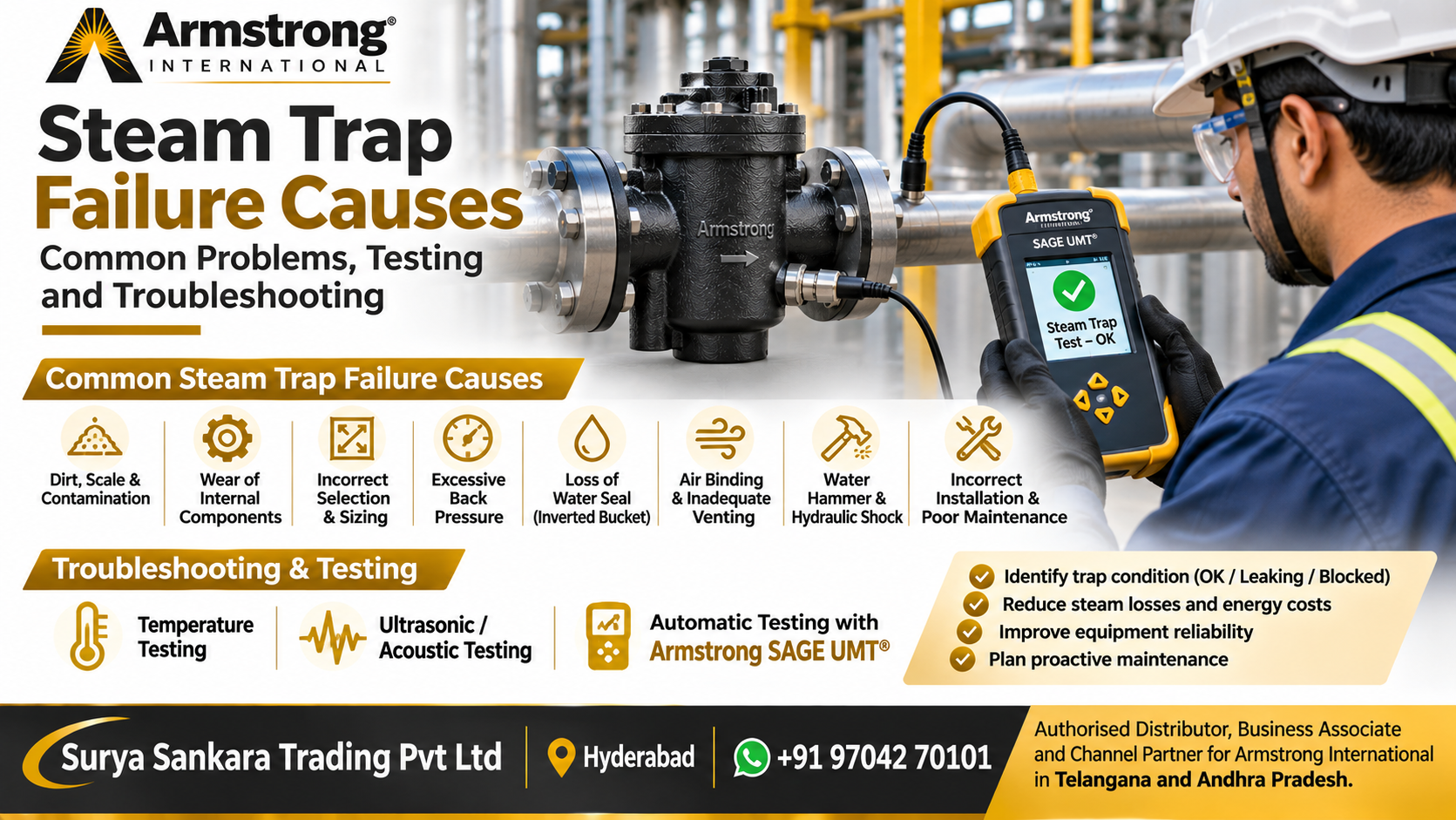
8 Common Steam Trap Failure Causes
1. Dirt, Scale and Pipeline Contamination
Industrial steam pipelines may contain rust, welding debris, scale and other solid particles.
These contaminants can accumulate inside steam traps, obstruct discharge passages or prevent valve mechanisms from closing properly.
Common symptoms: Restricted condensate discharge, irregular operation or continuous steam leakage.
Prevention: Maintain appropriate upstream strainers, remove accumulated debris and investigate recurring contamination sources.
Armstrong International offers inverted bucket steam trap designs with dirt-resistant features, but proper pipeline cleanliness remains essential.
2. Wear of Internal Components
Steam trap components experience repeated opening and closing cycles, pressure fluctuations and prolonged exposure to elevated temperatures.
Over time, valve seats, discs, thermostatic elements and mechanical components may deteriorate.
Worn sealing surfaces can permit live steam to pass through the outlet, increasing energy losses.
Prevention: Conduct periodic inspections and replace worn components using approved spare parts.
Some Armstrong International steam trap models feature repairable internal mechanisms, which may reduce the need to replace the complete unit.
3. Incorrect Steam Trap Selection and Sizing
Selecting an unsuitable steam trap is another important cause of operating problems.
Steam traps must be sized according to condensate load, operating pressure, back pressure, start-up conditions and application requirements.
An undersized trap may not discharge condensate adequately, while an unsuitable design may provide insufficient air removal.
Prevention: Use manufacturer capacity charts and application guidance instead of selecting a trap solely by pipe diameter.
Correct equipment selection is particularly important for steam-heated process equipment with changing operating conditions.
4. Excessive Condensate Return Back Pressure
High pressure in the condensate return line reduces the pressure differential available for steam trap discharge.
This may result from undersized return piping, restrictions, excessive flash steam or other system problems.
When insufficient differential pressure is available, condensate may accumulate even if the trap mechanism is functioning.
Prevention: Evaluate the downstream condensate return system and verify the available pressure differential.
Where process equipment experiences steam stall, a properly engineered pump-trap arrangement may be necessary.
5. Loss of Water Seal in Inverted Bucket Steam Traps
Inverted bucket steam traps rely on a water seal to prevent unnecessary live steam discharge.
Sudden or frequent pressure drops may cause the trap to lose its prime.
When this happens, steam may escape through the discharge valve until the water seal is restored.
Prevention: Review pressure fluctuations and installation conditions. Follow the applicable Armstrong International instructions for priming and any recommended check-valve arrangement.
6. Air Binding and Inadequate Venting
Air and non-condensable gases can accumulate in industrial steam-heated equipment.
If the air venting arrangement is inadequate or blocked, the system may experience delayed heating, uneven temperatures or poor condensate drainage.
Some float and thermostatic steam traps may become air-bound when their thermostatic vents malfunction.
Prevention: Verify air removal requirements, inspect appropriate venting equipment and select steam traps suited to the application’s start-up conditions.
7. Water Hammer and Hydraulic Shock
Water hammer can occur when condensate accumulates in steam piping and is rapidly accelerated or when other sudden hydraulic events occur.
The resulting forces may damage steam trap components, valves and surrounding pipework.
Hydraulic shock can also damage certain thermostatic elements.
Prevention: Provide suitable drainage arrangements, correct pipe slopes and appropriate steam trap locations.
Persistent water hammer requires investigation of the wider steam system, not merely replacement of damaged traps.
8. Incorrect Installation and Inadequate Maintenance
Installing a steam trap in the wrong orientation, reversing its flow direction or providing unsuitable piping arrangements can interfere with normal operation.
Maintenance deficiencies may allow dirt accumulation, leaking valves or worn components to remain undetected.
Prevention: Follow model-specific installation instructions, maintain access for inspection and establish regular steam trap testing procedures.
How to Identify Steam Trap Failure Symptoms
Maintenance personnel should watch for the following warning signs:
- Unexpectedly high steam consumption
- Continuous or unusual discharge behaviour
- Poor heating performance
- Condensate accumulation
- Water hammer or abnormal pipeline vibration
- Irregular equipment temperatures
- Unexpected increases in maintenance requirements
However, these symptoms are not sufficient to confirm a particular fault.
For example, flash steam is frequently mistaken for live steam leakage. When hot condensate enters a lower-pressure system, part of it may evaporate into flash steam even though the steam trap is operating correctly.
Proper testing is necessary before determining whether replacement is required.
How to Test Industrial Steam Traps
1. Temperature Testing
Temperature measurements can help engineers investigate abnormal operating conditions.
A trap that remains unexpectedly cold may indicate inadequate flow, blockage or another system problem.
However, temperature readings alone cannot reliably identify every leaking or malfunctioning steam trap.
2. Ultrasonic and Acoustic Testing
Acoustic testing instruments detect sounds associated with steam and condensate flow.
Trained maintenance personnel can use these measurements to assess operating patterns and identify possible leakage.
Testing results should be interpreted according to the steam trap type and actual system conditions.
3. Automatic Steam Trap Testing
Armstrong International offers the SAGE UMT® Automatic Steam Trap Tester, designed to support systematic steam trap inspections.
Its features include:
- Acoustic sensing technology
- Non-contact infrared temperature measurement
- RFID identification
- Steam trap condition assessment
- Integration with SAGE® steam system management software
- Digital inspection records and reporting
The technology can help identify normally operating, cold, leaking and blow-through steam traps.
Related product: Armstrong International Steam Trap Tester
Testing should be carried out by appropriately trained personnel following the manufacturer’s safety instructions.
Steam Trap Troubleshooting: A Practical Maintenance Checklist
When a steam trap appears to be malfunctioning, maintenance teams should follow a systematic assessment process.
- Identify the equipment: Record the steam trap model, application and installation location.
- Check operating conditions: Review steam pressure, return-line pressure and equipment load.
- Inspect accessible system information: Investigate strainer restrictions, valve positions and maintenance history using safe procedures.
- Conduct appropriate testing: Use suitable acoustic and temperature-based diagnostic methods.
- Determine the underlying cause: Distinguish an actual trap failure from incorrect sizing, back pressure or other system issues.
- Plan corrective action: Arrange approved repair, replacement or system modifications as necessary.
Steam traps and associated piping must be safely isolated, depressurised and cooled before maintenance. Never loosen connections or dismantle equipment while pressurised.
How to Prevent Steam Trap Failures
A preventive steam trap management programme can reduce the risk of undetected equipment problems.
Important measures include:
- Maintaining an accurate steam trap inventory
- Recording model numbers and operating conditions
- Verifying correct selection and installation
- Inspecting strainers and related equipment
- Conducting regular steam trap surveys
- Tracking recurring failures
- Maintaining repair and replacement records
- Investigating excessive steam losses
- Reviewing condensate return system performance
Inspection frequency should be based on equipment criticality, operating conditions and the plant’s maintenance programme.
Armstrong International’s SAGE® technologies can support organised testing records and maintenance planning.
Industrial Applications of Steam Trap Maintenance
Steam trap maintenance is important across industries using steam for manufacturing and utilities.
Pharmaceutical industries: Steam is used in suitable process heating, sterilisation-related utilities and other manufacturing operations.
Food processing and dairy plants: Steam systems support cooking, heating and associated production processes.
Textile industries: Steam is used in dyeing, finishing, drying and related thermal operations.
Chemical and petrochemical plants: Steam distribution and process heating systems depend on suitable condensate drainage.
Paper and pulp industries: Steam-heated drying equipment requires reliable condensate management.
Sugar industries: Steam is used in heating, evaporation and processing operations.
In each industry, correctly selected steam traps and systematic inspection can help support energy efficiency and reliable operation.
Armstrong International Steam Trap Solutions in Telangana and Andhra Pradesh
Surya Sankara Trading Pvt. Ltd. supports industrial customers seeking Armstrong International steam traps, testing technologies and related condensate management solutions.
Telangana: Hyderabad, Patancheru, Sangareddy, Medchal, Jeedimetla, Warangal and surrounding industrial areas.
Andhra Pradesh: Visakhapatnam, Vijayawada, Kakinada, Tirupati, Sri City and other industrial locations.
Customers can contact SSTPL for product identification, technical discussions, replacement enquiries and quotation coordination.
For relevant equipment information, visit our Armstrong International Inverted Bucket Steam Trap page.
Frequently Asked Questions About Steam Trap Failure Causes
1. What are the most common steam trap failure causes?
Common steam trap failure causes include dirt accumulation, worn internal components, incorrect sizing, improper installation, inadequate pressure differential and maintenance deficiencies. Pressure fluctuations and hydraulic shock may also contribute to failures. A systematic assessment is necessary because some apparent steam trap problems originate elsewhere in the steam distribution or condensate return system.
2. What happens when a steam trap fails open?
A failed-open steam trap may allow live steam to escape continuously into the condensate return system or another discharge location. This can increase fuel consumption, energy losses and condensate return system loading. The actual steam loss depends on operating pressure, discharge conditions and the size of the leakage path.
3. What happens when a steam trap fails closed?
A failed-closed or blocked steam trap may prevent condensate from draining properly. This can result in condensate accumulation, reduced heat transfer, poor process heating and increased water hammer risk. However, a trap with no discharge is not always defective; operating conditions and actual condensate production must also be evaluated.
4. How can industrial steam trap failures be detected?
Steam trap failures can be investigated using acoustic testing, temperature measurements and operating information. Armstrong International provides the SAGE UMT® Automatic Steam Trap Tester, which supports systematic inspection and condition assessment. Technicians should interpret diagnostic results according to the specific steam trap technology and operating conditions rather than relying on temperature alone.
5. Who supplies Armstrong International steam trap solutions in Telangana and Andhra Pradesh?
Surya Sankara Trading Pvt. Ltd., based in Hyderabad, is an Authorised Distributor, Business Associate and Channel Partner for Armstrong International in Telangana and Andhra Pradesh. Established in 2011, SSTPL supports industrial customers with steam trap product enquiries, technical coordination and information about Armstrong International testing and condensate management technologies.
Improve Steam System Reliability With Appropriate Maintenance
Understanding steam trap failure causes helps industrial plants identify operational problems, reduce avoidable steam losses and improve equipment reliability.
Regular testing, correct steam trap selection and appropriate maintenance are essential for dependable condensate drainage.
Surya Sankara Trading Pvt. Ltd. is an Authorised Distributor, Business Associate and Channel Partner for Armstrong International in Telangana and Andhra Pradesh.
For Armstrong International steam trap products, testing equipment and technical enquiries, contact:
Surya Sankara Trading Pvt. Ltd.
5-5-35/153 A, Prashant Nagar, IDA Kukatpally, Hyderabad – 500072, Telangana, India.
Phone / WhatsApp: +91 97042 70101
Email: suryasankaratraders@gmail.com
Website: armstrong.suryasankara.in
Contact Us: Send an Enquiry
Request a quotation: Share your existing steam trap model, steam pressure, condensate load, operating problem and plant location for product discussions and quotation coordination.
Technical references: Armstrong International – Steam Conservation Guidelines, particularly the troubleshooting section on page 51; Steam Trap Testing Technologies; and the SAGE UMT® product specifications