Inverted Bucket Steam Traps: Working Principle, Benefits and Industrial Applications. An inverted bucket steam trap is a mechanical device that removes condensate from industrial steam systems while limiting the escape of live steam. Its operating principle is based on the difference in density between steam and water. This simple mechanism makes it relevant to steam distribution networks, process heating equipment and other applications requiring reliable condensate drainage.
Condensate backup can reduce heat transfer and increase water hammer risk; live steam leakage raises operating costs. Understanding the mechanism helps engineers select and maintain equipment.
Surya Sankara Trading Pvt. Ltd. (SSTPL) is an Authorised Distributor, Business Associate and Channel Partner for Armstrong International in Telangana and Andhra Pradesh. From Hyderabad, SSTPL supports industrial enquiries for Armstrong International steam and condensate solutions.
What Is an Inverted Bucket Steam Trap?
An inverted bucket steam trap contains an upside-down bucket connected to a discharge valve through a lever mechanism. Steam collecting underneath the bucket makes it buoyant, raising it and closing the valve. As steam inside the bucket condenses or escapes slowly through a vent, the bucket sinks and opens the valve to release condensate.
The trap usually discharges in cycles, although condensate can enter between them. Armstrong International describes this as continuous drainage with intermittent discharge.
The water surrounding the valve outlet forms a seal that helps keep live steam from escaping during normal operation.
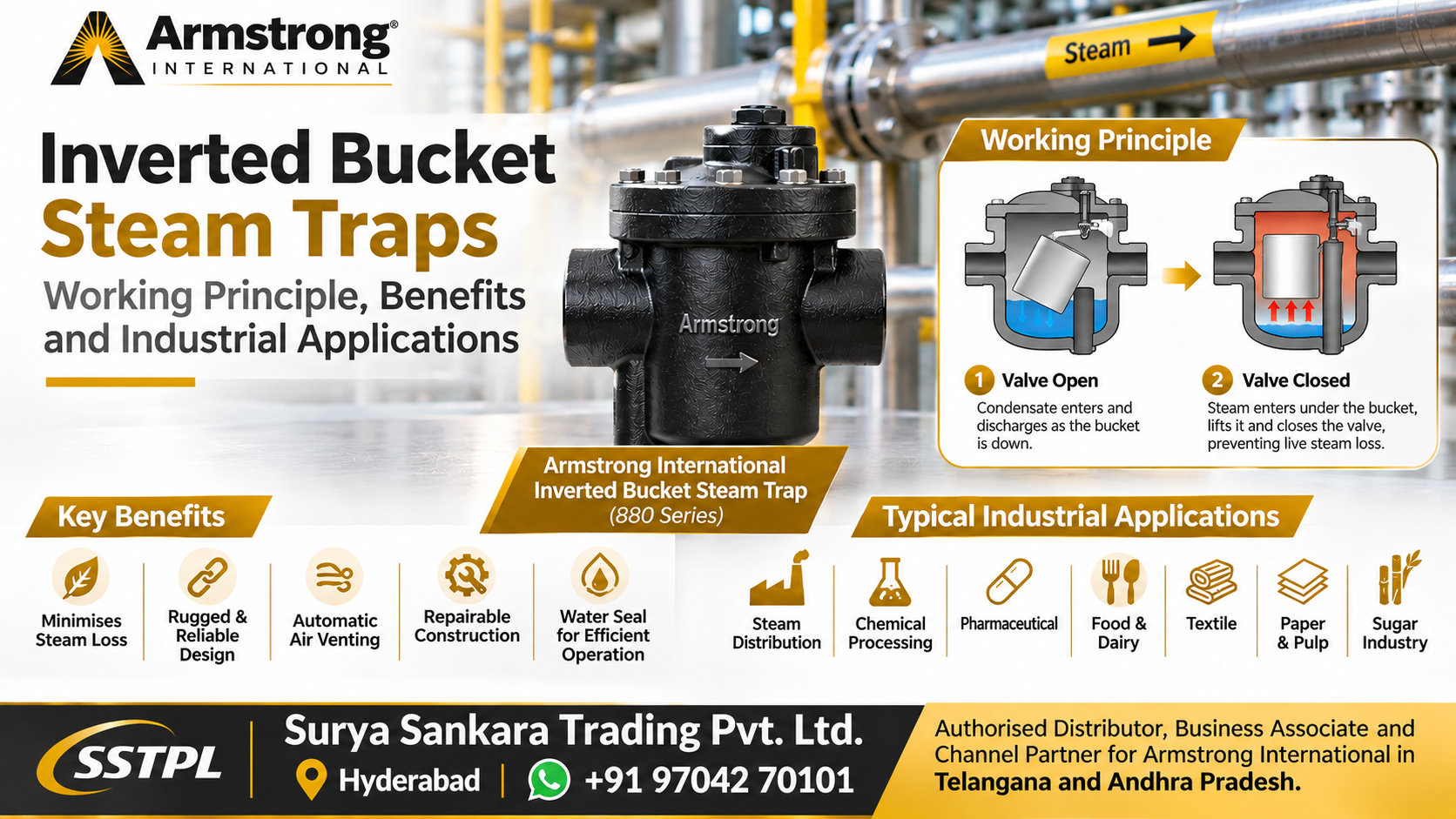
How Does an Inverted Bucket Steam Trap Work?
Step 1: Start-Up and Condensate Entry
At start-up, the bucket is normally down and the discharge valve is open. Air and initial condensate enter the trap, and condensate passes through the open outlet. Proper priming establishes the water seal needed for normal functioning.
Step 2: Steam Enters Beneath the Bucket
Steam flows underneath the inverted bucket and becomes trapped there. Because the steam-filled bucket is more buoyant than the surrounding condensate, it rises. The lever mechanism then closes the discharge valve, preventing unnecessary steam discharge.
Step 3: Air and Steam Vent Through a Small Opening
A small hole near the bucket’s top allows air and other non-condensable gases to escape. Some trapped steam passes through this hole and condenses. High start-up air loads require assessment because vent capacity is limited.
Step 4: Bucket Sinks and Condensate Discharges
As steam within the bucket condenses and buoyancy decreases, the bucket sinks. The lever opens the valve and the accumulated condensate is discharged through the outlet. Incoming steam eventually raises the bucket again, repeating the cycle.
Key point: Intermittent outlet discharge is normal for this technology; it does not automatically indicate a malfunction.
Main Benefits of Armstrong International Inverted Bucket Steam Traps
Reduced live steam leakage: The water-sealed discharge orifice helps prevent live steam from reaching the outlet when the trap operates correctly.
Durable mechanical arrangement: The free-floating lever mechanism used in relevant Armstrong International designs has no fixed pivots, reducing certain friction and wear points.
Resistance to dirt-related problems: A top-positioned discharge mechanism and periodic opening can help purge suspended particles, although good steam-system cleanliness remains essential.
Air and carbon dioxide venting: A vent in the bucket allows these gases to leave the trap without waiting for condensate to cool substantially.
Tolerance of challenging operation: Relevant models are designed to withstand demanding industrial conditions, including some water hammer exposure. They are not immune to poor piping design or severe pressure shocks.
Repairable configurations: Some cast-iron Armstrong International models have replaceable internal parts, potentially reducing whole-unit replacement costs. Repairability must be confirmed for the exact model.
Benefits depend on model selection, installation and maintenance.
Armstrong International 880 Series: An Industrial Example
The Armstrong International 880 Series is a cast-iron inverted bucket steam trap family intended for horizontal installation. Manufacturer information describes an integral strainer, a free-floating stainless steel operating mechanism, automatic venting and a discharge orifice positioned near the top of the body.
Models 880, 881, 882 and 883 vary in capacity, pressure rating and connections; confirm the specific model against current manufacturer data.
Read our Armstrong International Inverted Bucket Trap product page for product information and to start an enquiry.
Industrial Applications of Inverted Bucket Steam Traps
Steam Distribution and Drip Legs
Steam mains require drainage points to remove condensate formed through heat loss. A suitable inverted bucket steam trap can discharge this condensate and help protect the distribution system when matched to the actual operating conditions.
Textile and Paper Manufacturing
Textile processing and paper production use steam for drying, finishing and related operations. Inverted bucket technology may be suitable for selected steam drainage duties, but rotating dryers and controlled heating systems require careful arrangement and pressure-differential checks.
Food Processing, Dairy and Sugar Plants
Steam is used for heating, cooking and process utilities. Inverted bucket steam traps can serve appropriate steam distribution and equipment drainage applications. Variable process loads may sometimes call for alternative trap types or pumping solutions.
Pharmaceutical and Chemical Industries
These facilities require reliable steam distribution and process heating. Material compatibility, pressure ratings and air-removal requirements should be reviewed. Clean-steam or hygienic product-contact duties may require specialised equipment rather than an ordinary industrial steam trap.
How to Select the Right Inverted Bucket Steam Trap
Before requesting a quotation, prepare these operating details:
- Steam pressure at the trap inlet, including the lowest expected operating pressure
- Condensate return pressure and any elevation or back-pressure effects
- Normal and start-up condensate load in kg/h
- Maximum design pressure and temperature
- Application type: steam main, tracing, process heater or equipment drain
- Required connection size, connection standard and installation orientation
- Expected dirt, corrosion, freezing and maintenance conditions
A useful first check is available pressure differential = inlet pressure minus outlet pressure. The selected trap must have enough discharge capacity at the actual minimum differential pressure, including any applicable sizing allowance.
Do not size a steam trap solely by pipe diameter.
Installation, Testing and Common Problems
Incorrect orientation, an inadequate water seal, dirt accumulation, excessive differential pressure and unexpected return-line back pressure can all affect trap operation. In some designs, a sudden pressure drop may cause loss of prime; follow the model-specific installation instructions and evaluate whether a check valve is necessary.
A trap that blows continuously may be malfunctioning, but visible vapour at its discharge can also be flash steam from hot condensate, not necessarily live steam leakage. Temperature readings alone are not enough to diagnose every fault.
Regular inspection using suitable acoustic and temperature methods can help identify leaking, blocked or poorly operating traps. Armstrong International’s Steam Trap Tester page introduces SAGE UMT® equipment for systematic surveys.
Only trained personnel should isolate, depressurise, cool and service steam equipment; do not open a pressurised trap for inspection.
Armstrong International Steam Trap Distributor in Telangana and Andhra Pradesh
Surya Sankara Trading supports industrial customers in Telangana (Hyderabad, Patancheru, Sangareddy, Medchal and Warangal) and Andhra Pradesh (Visakhapatnam, Kakinada, Vijayawada, Tirupati and Sri City).
Our role is to help customers discuss product requirements, identify relevant Armstrong International technologies and coordinate enquiries for appropriate solutions. Availability, delivery times and any site testing or engineering services should be confirmed for each requirement.
Frequently Asked Questions
1. Why is it called an inverted bucket steam trap?
The name refers to the upside-down bucket inside the trap body. Steam collecting below the bucket makes it float, closing the outlet valve; as steam condenses or vents, the bucket sinks and opens the valve. The resulting repeated movement automatically discharges condensate while reducing unnecessary live steam losses when the trap is correctly selected and operating normally.
2. Does an inverted bucket steam trap discharge continuously?
The trap generally discharges intermittently, opening and closing as bucket buoyancy changes. Condensate can nevertheless flow into the trap between discharge cycles, so the equipment being drained need not experience condensate backup when the unit is correctly sized and installed. A continuous discharge pattern may occur under particular loads, but abnormal operation should be assessed using the model’s guidance.
3. What is the difference between an inverted bucket and a float and thermostatic trap?
An inverted bucket trap uses steam buoyancy and a mechanical lever to discharge condensate in cycles. A float and thermostatic trap generally uses a float for more continuous condensate discharge and a separate thermostatic vent for air. Neither is universally better; selection depends on the application, start-up air load, pressure differential and condensate behaviour.
4. Can inverted bucket steam traps reduce energy costs?
Yes, correctly working traps help prevent unnecessary live steam discharge while draining condensate from steam-using equipment. Maintaining a sound water seal and functional internal mechanism supports efficient operation. Actual energy savings depend on the previous trap condition, steam cost, operating hours and broader system performance. Savings should be measured or calculated rather than promised as a fixed percentage.
5. Where can I enquire about Armstrong International inverted bucket steam traps in Hyderabad?
Surya Sankara Trading Pvt. Ltd. is an Authorised Distributor, Business Associate and Channel Partner for Armstrong International in Telangana and Andhra Pradesh. The Hyderabad office supports product enquiries from local and regional plants. Share your existing model, steam pressure, return pressure, condensate load, installation details and required quantity for a suitable product discussion and quotation coordination.
Discuss Your Steam Trap Requirements
Inverted bucket steam traps provide a proven mechanical approach to condensate drainage using a buoyant bucket, water-sealed valve and intermittent discharge cycle. Their effectiveness depends on proper sizing, operating conditions, installation and periodic inspection.
Surya Sankara Trading Pvt. Ltd. — Authorised Distributor, Business Associate and Channel Partner for Armstrong International in Telangana and Andhra Pradesh.
Office: Prashant Nagar, IDA Kukatpally, Hyderabad – 500072
Phone / WhatsApp: +91 97042 70101
Email: suryasankaratraders@gmail.com
Contact: Send a product enquiry
Request a quotation: Send your plant location, steam and condensate pressures, condensate load and any existing trap model so SSTPL can discuss relevant Armstrong International options.
Technical references: Armstrong International 880 Series, 800 Series and the manufacturer’s steam trap operating guidance.