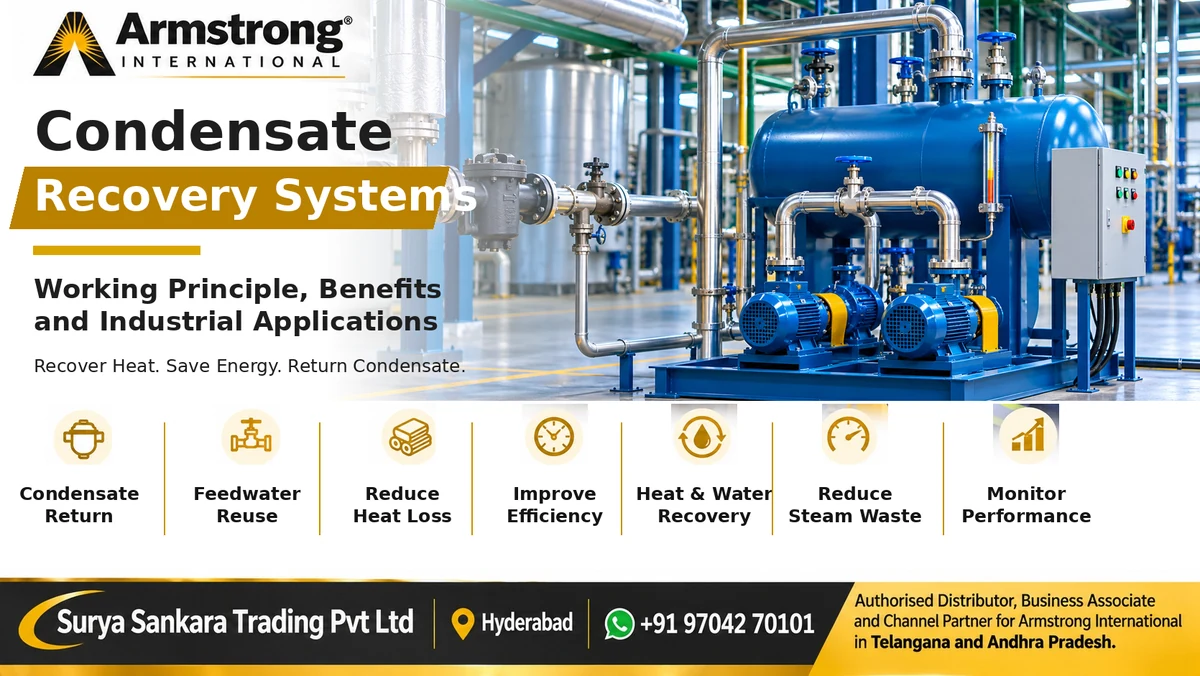
Industrial steam systems use heat to support processing, washing, drying, sterilisation, heating and utility operations. After steam transfers heat to equipment, much of it becomes hot water known as condensate. Discharging that condensate without assessing recovery opportunities can waste useful heat, treated water and boiler chemicals. Condensate recovery systems collect suitable condensate and return it for reuse, typically through the boiler feedwater system.
What Is a Condensate Recovery System?
A condensate recovery system is a network of steam traps, piping, collection vessels, pumps and controls that gathers condensed steam and directs it toward a suitable reuse point. The design depends on steam pressure, condensate temperature, return-line elevation, drainage requirements and the quality of recovered water.
Condensate is different from raw make-up water. It has already been treated within the boiler-water system and generally remains relatively hot. Where it is clean and chemically acceptable, returning it to the feedwater circuit can reduce the need to heat and treat replacement water. Armstrong International identifies fuel, make-up water and treatment chemicals as important opportunities in condensate recovery.
Why Does Condensate Still Have Value?
When steam condenses at a heat-transfer surface, the process receives the latent heat released by condensation. The resulting liquid can nevertheless retain substantial sensible heat. Armstrong International notes that, depending on pressure, condensate leaving a trap may contain approximately 20% of the heat energy transferred at the boiler as sensible heat. That is an indicative manufacturer figure, not a guaranteed saving for every installation.
How Condensate Recovery Systems Work
Step 1: Steam Transfers Heat to Equipment
Steam enters a heat exchanger, jacketed vessel, coil, dryer or another process user. As heat is transferred, steam condenses. Correct drainage is necessary because accumulated condensate can reduce heat-transfer performance and contribute to water hammer or unstable temperature control.
Step 2: A Suitable Steam Trap Removes Condensate
The steam trap permits condensate and non-condensable gases to leave while restricting the unwanted passage of live steam. Selection is based on the equipment load, start-up requirement, operating pressure differential and air-handling requirement. For an example of one design,
A correctly installed trap is essential, but it does not by itself guarantee that condensate will flow into a pressurised return header. Downstream back pressure and elevation differences must be assessed separately.
Step 3: Condensate Enters the Return Network
The outlet connects to a gravity return, pumped return or other engineered collection arrangement. A return line may carry hot water together with flash steam generated when high-pressure condensate enters a lower-pressure environment. Piping, separators and venting arrangements therefore require design attention; a condensate line is not always operating as a single-phase liquid line.
Step 4: Pumps Handle Difficult Pressure Conditions
Gravity alone may be inadequate when the destination is elevated, the return system has high back pressure or a heat exchanger operates at very low pressure under modulating steam control. Properly selected electric condensate pumps or mechanical pump traps can help move condensate under suitable conditions. For system-related products, check our steam pump trap package
Step 5: Recovered Water Is Assessed and Reused
Recovered condensate commonly reaches a receiver, deaerator or boiler feedwater arrangement. Before re-entry into the boiler circuit, operators must verify its quality and compatibility with the boiler-water treatment programme. Condensate exposed to product leakage, oil or process chemicals may need monitoring, segregation, treatment or rejection.
Main Components of an Industrial Condensate Recovery System
Steam traps: These remove condensate from steam distribution lines and heat-transfer equipment. Their capacity and operating behaviour influence whether the process drains correctly.
Condensate return piping: These lines carry collected condensate. Their sizing must account for flash steam, velocity, erosion risk, pressure drop and thermal expansion, not merely liquid flow rate.
Receivers and collection tanks: Suitable vessels collect incoming condensate and provide storage or surge capacity. Temperature, flash-steam handling and ventilation requirements influence the arrangement.
Pumps and pump traps: These transfer condensate when gravity or positive differential pressure is insufficient. Pump control and check valves must suit actual conditions.
Strainers, isolation valves and check valves: These support maintainability and appropriate flow direction. Their use and placement must follow the selected equipment instructions and system design.
Benefits of Condensate Recovery in Industrial Plants
Reduced Boiler Fuel Demand
Returning hot condensate generally reduces the heat required to raise incoming feedwater to boiler conditions. The potential saving depends on how much condensate is actually returned, its temperature at the reuse point and the efficiency of the boiler system. Insulation and sensible routing reduce avoidable heat loss before the water reaches the receiver.
Lower Make-Up Water and Chemical Requirements
Every kilogram of acceptable condensate reused can offset part of the demand for fresh make-up water. This may reduce water purchase, pumping, treatment and blowdown-related costs. However, the water balance must still allow for leakage, venting, intentional discharge and normal boiler blowdown.
Improved Maintenance Visibility
When plant personnel maintain an inventory of traps, return branches and pumping stations, they can identify recurring failure points. Testing is more reliable than judging a trap solely by its surface temperature. Our steam trap tester page describes Armstrong International’s equipment for systematic surveys.
For detailed information about condensate recovery technologies, industrial steam management and energy-efficient condensate return solutions, refer to Armstrong International’s Steam and Condensate Solutions. The manufacturer’s technical resources provide useful guidance for improving steam system efficiency and reducing operating costs.
Which Industries Benefit from Condensate Recovery?
In pharmaceutical manufacturing, steam supports utilities and processing. Recovery design must account for any possibility of process contamination, along with applicable quality and validation requirements. Clean or pure-steam condensate should not automatically be mixed into a plant utility return without approval.
In food and beverage plants, steam commonly serves cooking, heating, cleaning and production utilities. Condensate recovery may be economical, provided contamination risks are controlled and process hygiene requirements are met.
In textile processing, drying and finishing equipment can create sizeable and changing condensate loads. Trapping and the return network need to accommodate those operating variations.
How to Estimate the Potential Energy Benefit
A simple first-pass estimate considers the condensate mass flow, the temperature of condensate returned and the temperature of the make-up water it replaces. For illustration, suppose 1,000 kg/h of clean condensate reaches the feedwater system at 90°C instead of replacing it with water at 30°C.
Using a water specific heat of approximately 4.18 kJ/(kg·°C), the sensible-heat difference is about 251,000 kJ/h, or 70 kW of thermal power. This is a theoretical comparison of water enthalpy at those temperatures, not a prediction of net boiler fuel savings. Actual benefits must account for return fraction, feedwater mixing, boiler efficiency, flash-steam handling, pumping energy, tank losses and operating hours.
Common Problems and How to Avoid Them
Excessive Return-Line Back Pressure
A process trap requires adequate differential pressure. Excessive back pressure can reduce discharge capacity even when the trap itself is functional. In a modulated heat exchanger, low internal pressure may also cause stall. Engineers should consider differential pressure over the full operating range before deciding whether a pumping arrangement is needed.
Contaminated Condensate
A leaking heat exchanger can allow chemicals, oil or product to enter the condensate stream. Returning such water directly may damage boiler equipment. Establish appropriate sampling, monitoring, diversion and operator response procedures according to the process and boiler requirements.
Steam Trap Failures
A failed-open steam trap can waste live steam; a blocked or failed-closed trap can back up condensate. Establish routine surveys, maintain a trap register, use appropriate testing methods and prioritise repair according to the criticality of each steam user.
Practical Checklist Before Installing a Recovery System
Survey the Existing Steam and Condensate Network
Record steam pressure, typical and peak loads, condensate temperatures, available elevation, return-line pressure and the nature of each process user. Identify locations where condensate is currently discharged and explain why it is not being returned.
Questions for Your Plant Engineering Team
- Which streams are confirmed suitable for boiler reuse?
- What proportion of condensate can be collected throughout the shift?
- Can the return header handle flash steam and peak flow?
- Are pumping traps needed when process pressure falls?
- Who will test steam traps and verify water quality after commissioning?
Important Operating Note on Condensate Recovery Systems
A condensate recovery retrofit should be reviewed against the boiler manufacturer’s guidance, applicable pressure-equipment requirements and the plant’s water-treatment specifications. A generic piping layout is not a substitute for detailed engineering.
Frequently Asked Questions About Condensate Recovery Systems
What is the main purpose of a condensate recovery system?
Its main purpose is to collect suitable hot condensate and reuse its water and sensible heat, often by returning it to the boiler feedwater system. It can reduce make-up water and heating demand when correctly designed.
Can all industrial condensate be returned to the boiler?
No. Condensate contaminated by product, chemicals, oil or unsuitable treatment agents may require segregation, treatment or discharge. Water-quality acceptance criteria should be confirmed before reuse.
Does a condensate recovery system always need a pump?
No. Gravity or sufficient pressure differential can return condensate in some layouts. A pump or pump trap may be required when the return elevation or back pressure prevents reliable flow.
Can condensate recovery prevent water hammer?
Correct drainage and system design can reduce some water-hammer risks, but recovery alone does not eliminate them. Steam-line design, trap performance and operating practices all matter.
How often should steam traps be tested?
Inspection frequency should reflect steam trap duty, plant criticality, observed failure rate and site maintenance policy. High-consequence applications may need more frequent checks than low-risk services.
Condensate Recovery Systems Support in Telangana and Andhra Pradesh
Surya Sankara Trading Pvt Ltd is an Authorised Distributor, Business Associate and Channel Partner for Armstrong International in Telangana and Andhra Pradesh. Based in Hyderabad, we support industrial customers looking for suitable steam traps, steam pump trap packages and improved condensate management for plant utility systems.
Plant maintenance managers, utility engineers and purchase teams in Hyderabad, Medchal, Sangareddy, Warangal, Visakhapatnam, Vijayawada, Guntur and other industrial locations can discuss application requirements with our team. Product selection and system performance should always be based on actual operating data.
Request a discussion on Condensate Recovery Systems: Call or WhatsApp +91 97042 70101, or email suryasankaratraders@gmail.com. Visit our website Armstrong International solutions homepage</a> to explore related industrial steam products.